Foreigners Praise Beijing's Ecological Progress and Urban Development

On May 29, the Information Office of Beijing Municipality held the "Embarking on the 15th Five-Year Plan" Beijing Special Press Conference.
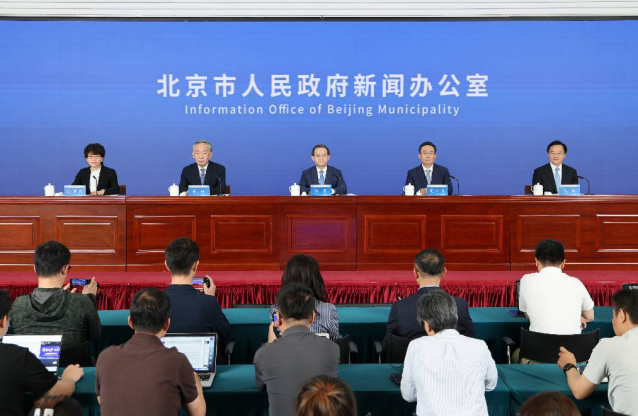
Scene of the press conference
[Photo via People's Government of Beijing Municipality]
According to the press conference, Beijing's regional GDP grew at an average annual rate of 5.2 percent over the past five years, with the city's economic output successively surpassing the 4-trillion-yuan and 5-trillion-yuan milestones. Significant achievements were made in the pilot reform initiatives in Zhongguancun and the development program of the Integrated National Demonstration Zone for Opening up the Services Sector and the China (Beijing) Pilot Free Trade Zone, while R&D investment intensity ranked among the highest globally. The city has also cultivated three industrial clusters, each worth over one trillion yuan, and seven industrial clusters, each worth over 100 billion yuan.
In the cultural aspect, the Beijing Central Axis was inscribed on the UNESCO World Heritage List after a 12-year journey, making Beijing the city with the most World Cultural Heritage sites in the world. The city has also made notable progress in building itself into a hub for performing arts, museums, and reading culture.
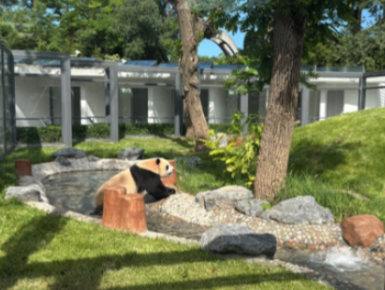
Environmentally, through sustained and systematic efforts, Beijing's annual average concentration of PM2.5 has met national standards for five consecutive years. "Beijing Blue" has become the norm, forest coverage has reached 45 percent, and the city now boasts more than 1,130 parks. Beijing has also been recognized by the United Nations as a Biodiversity Charming City.
Looking ahead to the 15th Five-Year Plan period, Beijing aims to maintain an annual regional GDP growth rate of 4.5 to 5 percent. While striving to take high-quality economic development to a new level, the city will also work to continuously improve environmental quality. It plans to further reduce major pollutant emissions, lower carbon intensity, increase the proportion of colorful vegetation to 24.2 percent, achieve initial results in developing a garden city, and make significant progress in building a Beautiful Beijing.
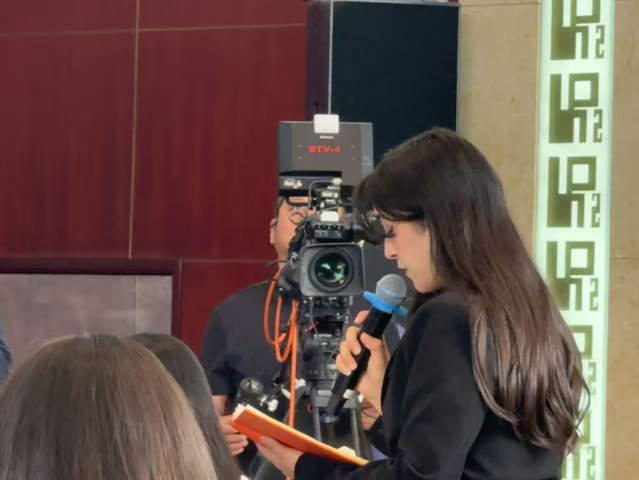
Asmaa, a foreign reporter from China Arab TV, asked a question at the press conference
[Photo by Nie Yuanlin]
Asmaa, a journalist from Tunisia working for China Arab TV, raised a question during the press conference. In her question, she noted that many waterfront areas in Beijing have seen remarkable improvements in recent years. She cited the Liangma River International Waterfront as an example, describing it as vibrant and beautiful and adding that she and her friends enjoy strolling along the river and taking boat rides there.
During the 15th Five-Year Plan period, Beijing plans to establish a waterfront network centered on the city's core districts and the Beijing Municipal Administrative Center. The plan includes creating two north-south ecological and cultural corridors along the Yongding River and the Grand Canal, as well as four distinctive east-west waterfront corridors connecting central Beijing with the administrative center. The city also aims to ensure that each district has at least one vibrant waterfront space suitable for both relaxation and recreation.
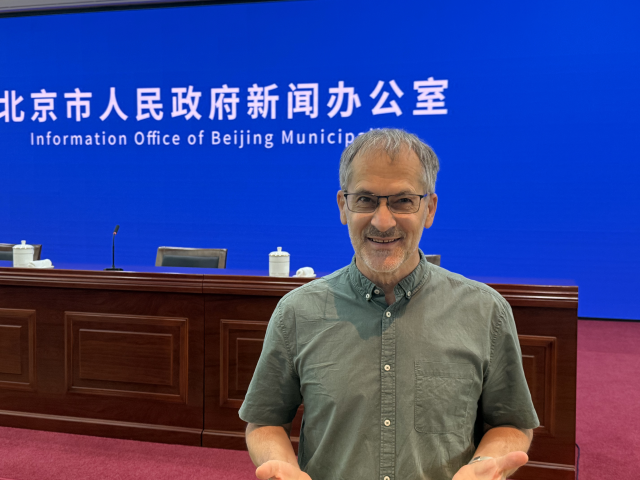
Bryan Allen, a foreign teacher at Communication University of China
[Photo by Nie Yuanlin]
Bryan Allen, a British teacher at the Communication University of China who has lived in China for more than 20 years, praised Beijing's public spaces after attending the conference. "I recently visited the Liangma River, and the scenery there was really impressive," he said. "There are bars and restaurants along the river where you can sit and enjoy the atmosphere." He also highlighted Beijing's extensive park system: "Beijing's parks are exceptionally well maintained, with excellent facilities and beautiful landscape. There are over a thousand such parks across the city, providing residents with free access to high-quality public spaces."
(Source: CRI Online)