Travel Routes Announced: Beijing Has 114 More Micro Gardens Transformed from Unused Spaces

Another 114 urban micro gardens in underused corner and edge spaces — known as "golden corners and silver edges" — across Chaoyang and Fengtai districts. Each measures 50 to 400 square meters, and together they cover about 12,000 square meters. These micro gardens are divided into six categories, such as garden streets, garden residential areas, garden commercial districts, and garden offices, catering to the needs of different people.
This May, a national-level competition for the design and construction of such gardens kicked off in Beijing. A total of 331 teams from 26 provinces, autonomous regions and municipalities across China signed up, submitting 346 proposals in the open category. Participants included professional designers, university faculty members and students in the fields of landscape architecture and environmental design, and public participants such as gardening enthusiasts and even primary and secondary school students.
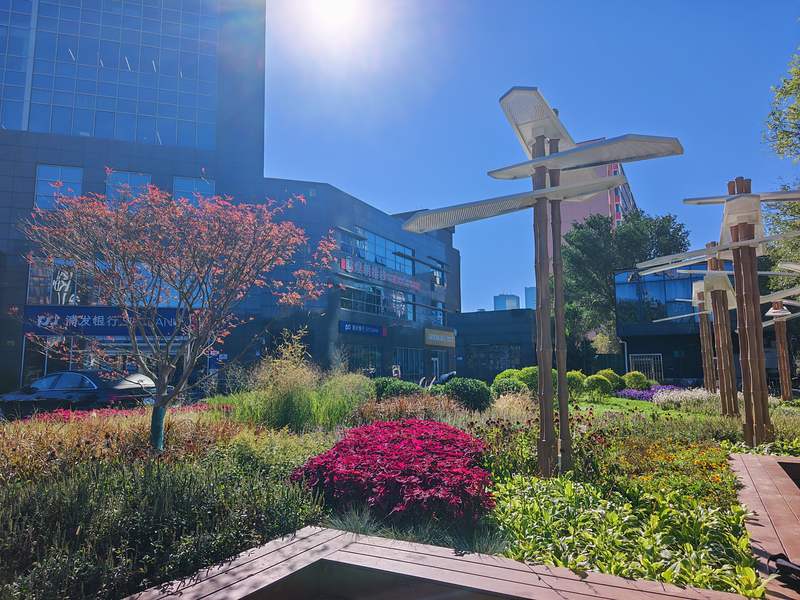
The "Bamboo Shadow Flower Courtyard" (竹影花庭) micro garden
[Photo by Zhang Lu from The Beijing News]
The competition selected 114 vacant corner and edge spaces in Chaoyang and Fengtai districts. Participants turned the design proposals into actual gardens to be permanently retained.
A representative work is titled "Bamboo Shadow Flower Courtyard", which is located near Zhong Yu Plaza in the heart of Sanlitun, a vibrant commercial district with international flair. The garden uses perennial flowers and ornamental grasses that can survive winter outdoors. They are water-saving and drought-tolerant, keeping long-term maintenance costs low. The micro garden uses two types of bamboo materials, reconstituted bamboo and glued laminated bamboo, which not only reflect Chinese elements, but are also green and environmentally friendly. The "Bamboo Dragonfly" (竹蜻蜓) pavilion offers visitors shade and a place to rest.
These micro gardens span many diverse types, including science-education and healing gardens, neighborhood social gardens, and history-themed gardens. They not only improve the quality of the urban landscape but also enhance leisure and recreation functions, while providing replicable and scalable models for urban micro garden development.
Based on the 114 urban micro gardens, the competition launched three walking routes featuring these sites.
1. "Garden Commercial Street, Colorful Chaoyang" (花园商街•缤纷朝阳)
This links urban landmarks and commercial areas such as Chaoyangmen, Sanlitun, Tuanjie Lake, and Chaoyang Park, as well as community micro gardens.
2. "Gathering Fragrance Along the Southern Axis, Seeking Fragrance on the Imperial Road" (南轴拾芳•御道寻芳)
This starts from Puhuangyu Subway Station and links neighborhood pocket gardens such as Xingguang Garden (星光花园) and Liucai Park (榴彩公园), as well as the Corridor of Delight and Discovery (知趣探趣长廊).
3. "Micro Life in Alleys, Revitalizing Huaxiang" (巷陌微生•花乡焕新)
This starts from Caoqiao Subway Station in the east and ends at Fengtai Station Memory Micro Garden (丰台站记忆微花园) in the west, revitalizing corner spaces such as vacant lots along urban side roads, river mudflats, gaps between walls, demolition sites, and former railway sites.
(Source: The Beijing News)