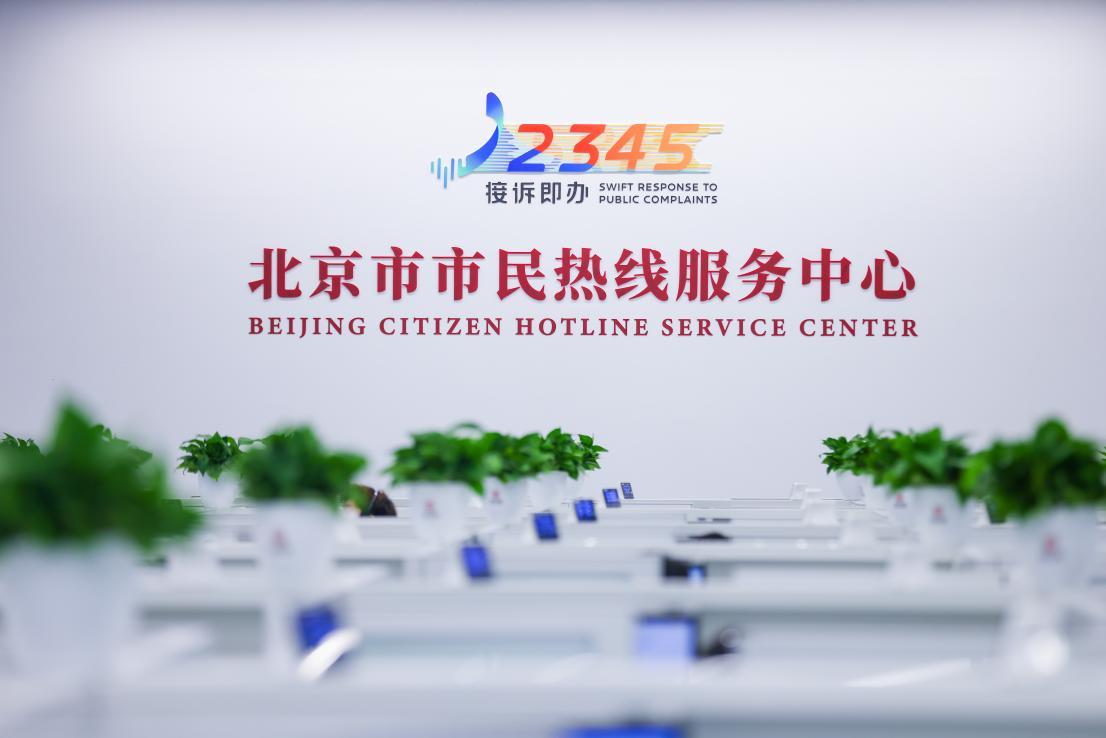
"My companion and I are visiting Beijing from Russia for the first time, and we got lost at the Fengtai Railway Station. Could you please help us?" This March, a multilingual operator at the Beijing Citizen Hotline Service Center received the call. After the request was assigned to the station's smart command center, staff quickly reviewed surveillance footage to pinpoint the travelers' approximate location, then arranged for volunteers to help them find their way to the boarding entrance. The visitors gave enthusiastic thumbs-up.
This cross-language assistance for two travelers is just one of the numerous real cases of support provided by the 12345 service hotline to international visitors and foreign residents.
When you are in a foreign country and run into trouble, who can you turn to for help? Beijing offers a simple, effective solution: call 12345 for a prompt response!
Since 2019, Beijing has been implementing its "Swift Response to Public Complaints" reform, centered on the city's 12345 hotline. Over the past seven years, the hotline has handled approximately 200 million cases. With more than 1,700 operators working around the clock, the hotline provides a channel for Beijing's residents, foreign nationals living and working in the city, and businesses and other organizations in the city to seek help with problems. The "Swift Response to Public Complaints" mechanism has established a coordinated governance framework involving multiple parties, forming a closed loop of "acceptance, assignment, handling and evaluation". It has become a bridge between the governments and the people, through which public opinions can be heard, while also empowering the modernization of mega-city governance.
As Beijing welcomes a growing number of international visitors, it is also attracting more foreign nationals who choose to live and work in the city. Through its services for foreigners, the 12345 service hotline — dubbed the "China Hotline" — not only helps international visitors with travel-related issues and foreign residents with everyday matters, but also provides a channel for them to participate in grassroots governance. It has become a window through which the international community can gain insight into Beijing and China's approach to governance.
The 12345 service hotline currently provides round-the-clock services in eight languages in addition to Chinese. Along with the "12345 Online" platform, the "GO BEIJING" platform, the English version of the Jingtong app, the International Web Portal of Beijing, and airport service counters, it forms a three-dimensional network of services for foreign nationals, addressing their needs through their journey — from pre-trip planning and entry into China to everyday life in Beijing.
In June, more than 20 young scholars from Latin American think tanks visited the Beijing Citizen Hotline Service Center to learn firsthand how it operates. "Services are also designed for people who cannot communicate verbally and rely on sign language, reflecting genuine respect for and inclusiveness toward every citizen," said Orlando Roca, a Bolivian scholar.
Visitors to the service center in recent years have included the mayors of Minsk (Belarus) and Bangkok (Thailand), Angola's Minister of State, and a delegation from the Asia Society (based in the United States). To date, nearly 2,500 foreign nationals from more than 120 countries have visited the center to learn about the "Swift Response to Public Complaints" mechanism and observed the full call-handling process up close.
Omar Razzaz, a Senior Fellow at the Harvard Kennedy School and a former Prime Minister and Minister of Defense of Jordan, has actively promoted the "Swift Response to Public Complaints" mechanism on many occasions, including in Harvard's classrooms, at the annual meetings of the American Political Science Association, and in Gulf countries. Razzaz praised the 12345 service hotline as a model of efficient and balanced governance, saying that it achieves a deep integration of technological empowerment and institutional innovation. Having seen similar practices in other countries, Razzaz remarked that the overall performance of this mechanism was truly impressive and that its practice should be shared with the world.
Delegations from Belarus have visited the center three times to learn from Beijing's 12345 hotline, and plan to draw on its experience to establish a similar hotline in Belarus.
The 2026 Beijing Forum on Swift Response to Public Complaints will open on October 12. More than 240 international participants from over 70 countries will discuss common challenges in urban governance worldwide. For the first time, the forum will publish an English monograph on the "Swift Response to Public Complaints" reform and, in cooperation with a leading international journal, launch an English special issue on the subject. The forum will also present a series of achievements, including research findings on the theory behind the reform, reports evaluating urban hotline services and governance effectiveness both in China and internationally, and case studies of urban governance from around the world.
Scan the QR code for more information about Beijing's "Swift Response to Public Complaints" reform.

(Source: Reference News)