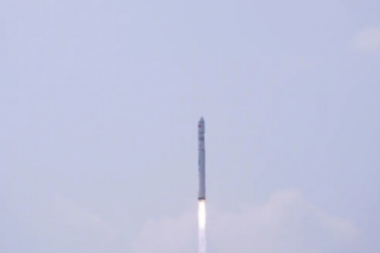
At 6:00 on September 16, the Gravity-1 Y3 carrier rocket, developed by Beijing-based commercial aerospace company Orienspace, lifted off from the East China Sea. It successfully placed eight Spacesail (Qianfan) constellation satellites and one Enhanced Ultra High Throughput (EUHT) technology test satellite into their designated orbits. The mission set new national records for payload mass and orbital altitude in a single sea launch, demonstrating the suitability of sea-based launches for missions involving medium and large satellite payloads.
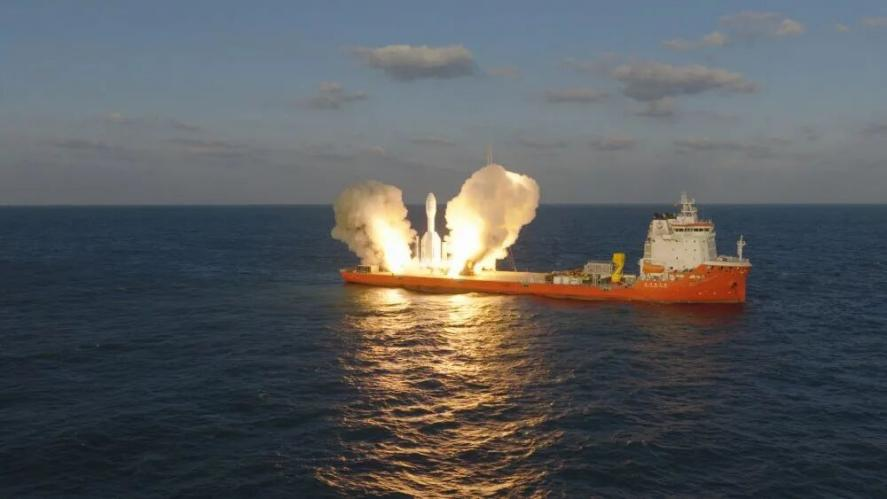
Xinhua (Photo via Orienspace)
The rocket primarily carried satellites for China's low-Earth orbit (LEO) satellite internet constellation, Spacesail (Qianfan). The net payload mass exceeded three metric tons, and the satellites entered orbit at an altitude of 800 kilometers.
The mission also marked the world's first mobile sea launch for the deployment of a LEO broadband internet constellation. The payload combined stacked satellite assemblies with flat-panel satellites, requiring more sophisticated control of multiple separation events.
As the world's most powerful solid-propellant carrier rocket currently in service, Gravity-1 uses a "rideshare" model to carry different satellites on a single launch, maximizing available space and significantly reducing per-satellite launch costs. According to Orienspace, Gravity-1 missions are scheduled at a rate of one launch every two months, allowing the rocket to routinely handle batch launches for constellation deployment. Rockets with greater payload capacity and reusability, designed to further reduce launch costs, are also under development.
(Source: Beijing Daily)