
'I Understand You': Deep Confession of Love from Brain-Computer Interface...

Inthe blink of your eyes,WeChat'snotification dot reminds you that you have over 200 unread messages.
How could you ever deal with such a backlog, especially when
you don't
feel liketypingor even send a voice message…"If
only I could reply just by thinking, without having to lift a finger
or utter a word..."
"I
hope to regain control over my own body and return to a normal life
someday..."This
thought is shared by peoplewho
have beenquadriplegicfor over a decadedue to severe spinal cord injuries.Is there any hope of someday regaining control of their lives?
And
how
does alittle monkey in the chair manage to grab the strawberries with a
mechanical arm without moving its own arms?
Make a list of current scientific research projects that sound like something out of science fiction and you'd have to include brain-computer interfaces(BCIs).
BCI technology serves asan information superhighway between the brain and external devices. It isat the forefront of next-generation human-computer interaction and hybrid human-machine intelligence.
In a nutshell,eachBCI captures the subtle changes to electrical signals in yourbrain, decodes yourbrain's intentions toallow you tocontrol actions with the mindand operate machines without having to actually move.
So,
what is the prospectfor the application of BCI technology?How is it growingin Beijing? Let's
find out more about the future of health from the recent "New
Quality Productive Forces in Beijing"interview on brain science and BCI.
BCIsBreak into the ‘Three-Pound
Universe'and Serves
as a Great Assistant for Those with Hemiplegia
The
human brain consists of tens of billions of interconnected neurons in
a complexity not unlike that of the universe itself. Scientists have
nicknamed it "three-pound
universe"on account of its weight of about 1,000 grams, or roughly three
pounds. BCItechnologyisprogressingfast, opening a window onto thesecrets ofhuman brains.
There
are two types of BCIs:invasive and non-invasive ones,depending on whether electrodes or chips have been implanted in thebrain.Currently,invasive
BCIs
are more advantageousin terms of the quality of the signal acquisition, spatial
resolution, and accuracy of neural modulation. However, such
BCIsalso face many challenges, such as the involvement of multiple
disciplines, long-termresearch and development, the need for integrated system
breakthroughs, and concerns about clinical
safety.
In
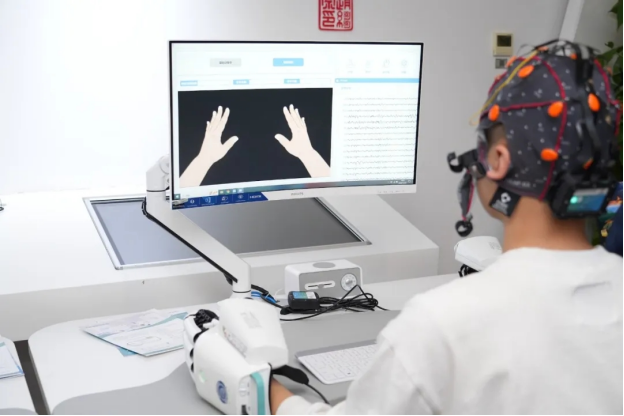
an event at Tiantan Hospital, I saw a hemiplegic patient named Li
Liang (presudonym)
don an electroencephalogram (EEG) information collection cap and
robotic exoskeleton to control the movement of the robotic arm with
EEG signal commands. While the brain controls external devices, hand
movements also send feedback to the neurons in the brain, forming a
closed loop that facilitates neural function recovery.
"Approximately
30percentof stroke patients experience varying degrees of sequelae. When a
patient's
motor neuron circuit has been damaged, what
theconventional rehabilitation can doisto restore partialfunctionality. BCItechnology, however, can bypass the damaged nerves to serve as a
functional substitution,"saidYang
Yi,
a chiefphysician
of the Neurosurgery Centerof Tiantan
Hospital.

After nearly a year of rehabilitation and training, Li Liang returned to work as a software engineer.
Thus it would appear that BCI could be communicating directly with the mind andproviding hemiplegics with a certain degree of mechanical support in the near future.
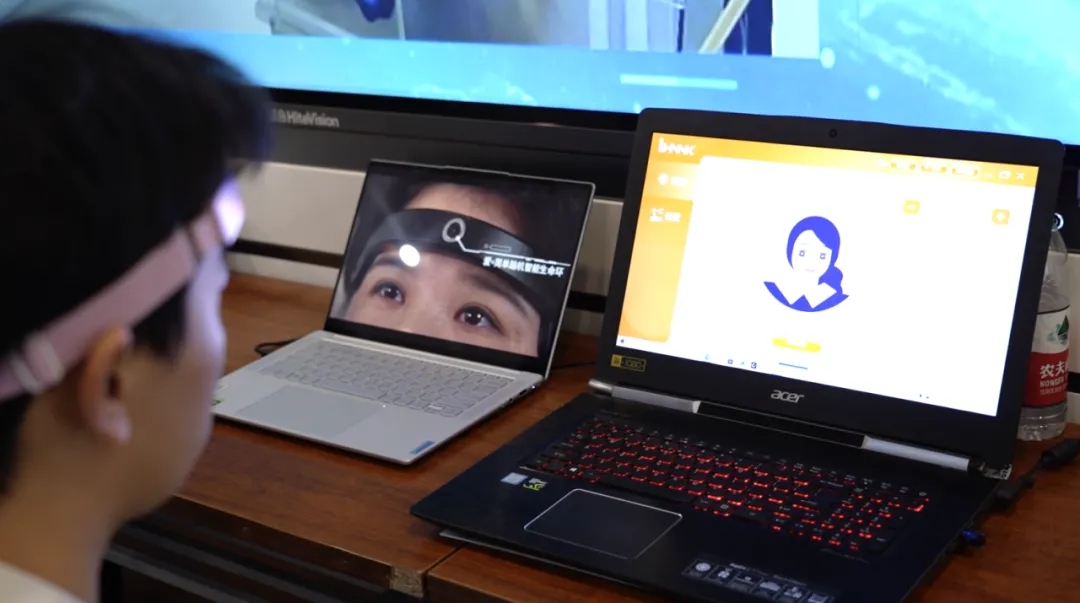
At the hospital, I also saw BCI products developed at Tiantan Hospital, such as a brain-controlled wheelchair, amindfulness meditation system, aconcentration training system, anartificial intelligence (AI) mouse, abrain-controlled typing system, and amultimodal intelligent rehabilitation platform, among others.
Connection to Brains Realized Through Electrocords: Updates on the Latest Research from BeinaoNo. 1 and BeinaoNo. 2
BeinaoNo. 1 and BeinaoNo. 2 were developed by the Chinese Institute for Brain Research, Beijing (CIBR, Beijing) in conjunction with Beijing Xinzhida Neurotechnology Co., Ltd. The two entities also introduced their latest advancements for this interview.
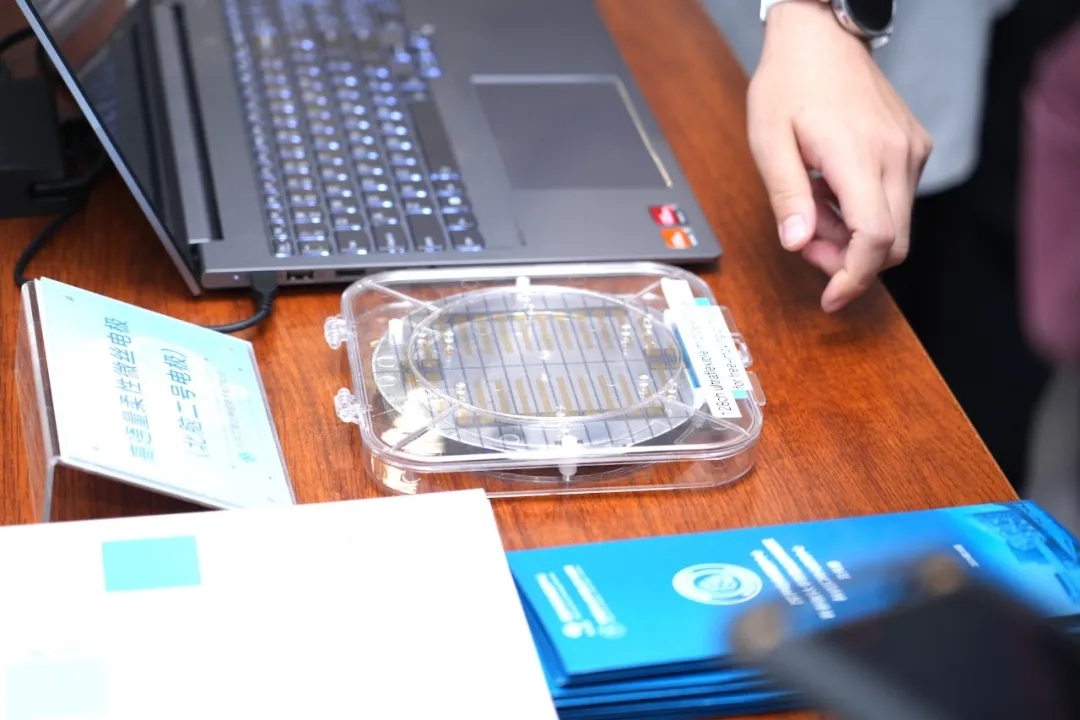
"High-density
flexible cortical electrodes with hundreds to thousands of channels
have already been developed for BeinaoNo. 1 and implanted in small animals for over six months,
demonstrating long-term stability in impedance and signal quality.BeinaoNo. 1's
wireless fully-implanted
microsystem is expected to be integrated and enter the clinical
research stage for long-term human implantation and decoding by early
2025. We have been working closely with clinicalinstitutions such as BeijingTiantan
Hospital, Xuanwu Hospital, and Sanbo Brain Hospital, and have
initiated six clinical studies, all approved by the hospitals, with
patient recruitment underway,"said
Li Yuan, Director
of Business Development ofBeijing Xinzhida Neurotechnology Co., Ltd.
BeinaoNo. 2 has achieved brain-controlled interception of two-dimensional moving targets in non-human primates, a global first.
In the video shown on site, a small monkey sitting in a chair could be seen staring intently at a screen and moving the circular icon on the screen with its thoughts.
The
feat was made possible by a high-throughput flexible microwire
electrode, one of the three core Chinese components independently
developed for BeinaoNo. 2, implanted in the monkey's
skull. The microwire, along with the thousand-channel high-speed
neural signal acquisition device, and the generative neural decoding
algorithm based on feedforward control strategy, pioneered by Chinese
scientists, consa "Made
in China"solution for BCI.
The
filament-like flexible electrodes act as sensors and are
requiredto accuratelycapture
as many EEG signals as possible, with the algorithm acting as a
translator deciphering the brain's
intentions. The system has been implanted in the rhesus monkey's
skull for a year and remains stable. In addition to controlling the
cursor on the computer screen, it can also operate a robotic arm to
intercept and grasp dynamic targets through brain control.
"Next,
we will move forward with the clinical application of a wireless,
fully-implanted
high-channel, high-performance BCI system to help patients with motor
and language impairments caused by spinal cord injuries, stroke, and
amyotrophic lateral sclerosis (ALS) to achieve functional
reconstruction and improve their quality of life,"said
Li Yuan.
(Sources: Beijing Municipal Science & Technology Commission, Administrative Commission of Zhongguancun Science Park)