

It’s morning and your curtains automatically draw open to reveal the date, temperature, humidity, and what to wear on the window glass. You walk out of the door and look up at the drones flying back and forth delivering orders to customers... What year can we expect this science-fiction to become a reality? Answer: Around 2030.
Today we will look at how 6G will change our world in the "New Quality Productive Forces in Beijing" — A Collective Interview of Sixth Generation Mobile Communications.
Be Fast and Reshape the World
6G is the sixth-generation mobile communication standard, the G standing for Generation.
3G,4G,5G… the increase of each number means that the mobile communication system is updated and iterated every 10 years, Therefore, the industry generally expects that 6G will be initially launched into the market and enter the lives of general public around 2030.
How fast could 6G Be? To put things in simple examples: With the 6G network it will take you less than 1 second to download a movie; It will make unmanned driving more stable and the operation of drones more precise. So, slow download speeds and network outages will never happen again in the world of 6G.
6G will be more than 10 times faster than 5G, with peak speed expected to reach 1Gbps (i.e., 1000 megabits per second), ushering in a mobile era of the Gigaband for us.
But 6G is more than a leap in communication speed. It is the in-depth integration of the physical world, virtual world and human world. It is a technological innovation that will pave the way for the development of digital twins and intelligent society, and may bring unprecedented changes in social forms. The strong fusion capability of 6G can combine multiple functions such as communication, sensing, computing, AI, big data, and security together, far beyond the reach of current 5G.
According to China Mobile Research Institute Chief Researcher He Hongjun, 6G will support a host of new application scenarios, like holographic communications and the remote transmission of vision, hearing, touch, smell, taste, and emotions for interaction, truly connecting the real world with the digital world. In simple terms, with such a magical synaesthesia internet, immersive experiences can become our daily life: Sitting at home you can feel the sea breeze of the Maldives; Doctors in Beijing can perform surgeries for patients in remote mountainous areas without actually going there... Users of the 6G network can have their own AI personal assistant, combining communication, perception, computing, AI, big data and other abilities, it can know you better than yourself. The holographic conferences of science fiction movies will become a reality.
6G is more than a better network speed, it is a new way of life and will promote the in-depth integration of industrial internet and IoT to eventually achieve the Internet of Everything.
As Xu Fei, director of Zhongguancun Pan Mobile Communication Technology Innovation and Application Research Institute 6G R&D Center, put it: "Speed is only the most basic advantage of 6G. The changes brought by 6G in the future will be subversive."
6G: An Accelerated Update in Progress
Computers exposed to light quickly access the internet and play videos. When the light is blocked, the internet disconnects immediately and the video play stops.

In China Mobile International Information Port’s visible light communication pilot zone 6G laboratory, a researcher is demonstrating how the technology works.
"The optical signal of visible light can be converted into an electrical signal via the photoelectric converter to transmit information," China Mobile Research Institute Chief Researcher He Hongjun said. "The transmission efficiency of visible light is high and is not interrupted by traditional RF signals," adding that communication of this kind is advantageous for low power consumption and high energy efficiency and is suitable for sensitive industries such as aircraft, hospitals, and industrial control, confidential in transmission and unaffected by electromagnetism.
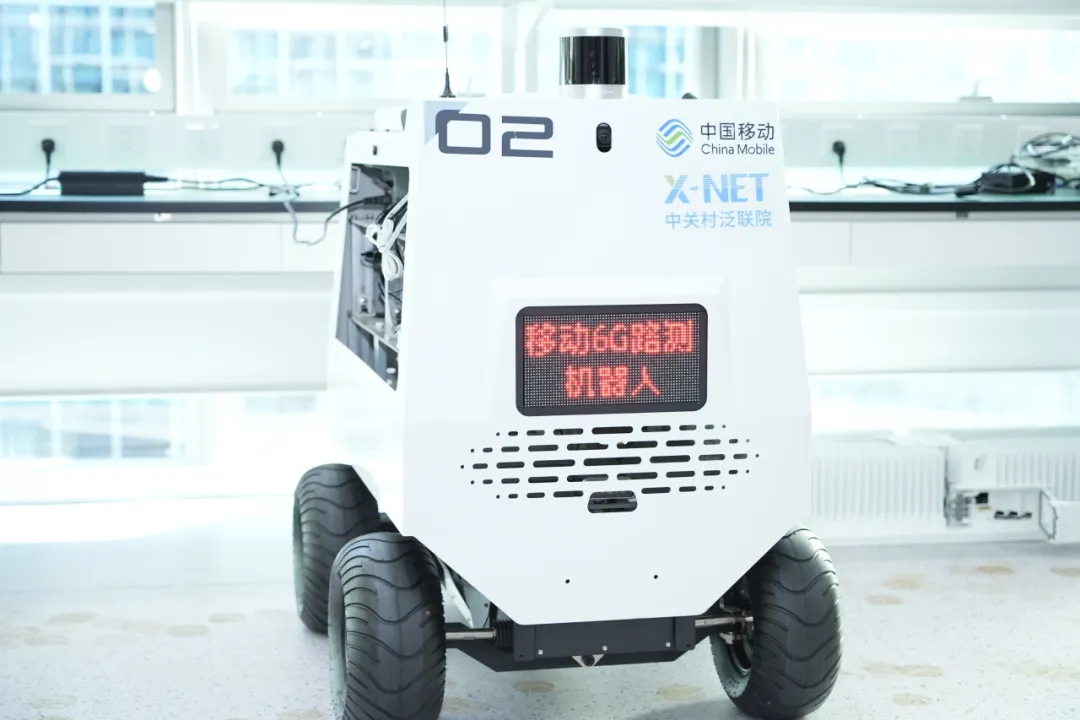
The route of this small unmanned vehicle shuttling back and forth through the laboratory is displayed on the computer screen in real-time with specific parameters such as speed. He Hongjun explained that communication signals could transmit sensations along with information, equivalent to installing a radar device in the base station to detect the movement of drones and unmanned vehicles. The sensing radar could track the testing vehicles in real-time and effectively employed in unmanned driving in the future.

The 6G terminal prototype in the laboratory successfully transmits a naked-eye 3D video. With the support of 6G, it is expected to achieve naked eye 3D.
6G is being tested with a variety of key technologies in the China Mobile International Information Port 6G laboratory. At present, China Mobile Research Institute and Zhongguancun Pan Mobile Communication Technology Innovation and Application Research Institute are actively developing the 6G prototype system and constructing an experimental network. They have preliminarily built a small-scale central 6G experimental network at Mudan Yuan in Haidian District and information port in Changping District to support multi-band converged networking using sub-7GHz, millimeter waves and visible light for the research and development of automatic test systems and verification of a dozen new 6G technologies.
The Zhongguancun Pan Mobile Communication Technology Innovation and Application Research Institute, co-founded by China Mobile, Beijing University of Posts and Telecommunications, and TD Industry Alliance in 2021, has been actively promoting 6G technology innovation and ecosystem construction. Bringing together a high-level research team led by academics and industry experts, it has produced major scientific and technological achievements recognized by the ZGC Forum for two consecutive years, becoming an important part of Beijing Municipality’s innovative next-generation mobile communication ecosystem.
Zhongguancun Pan Mobile Communication Technology Innovation and Application Research Institute’s 6G achievements are truly remarkable and include several 6G prototypes and innovations recognized globally, establishing a complete semantic information theory framework to extend the theoretical limits of communication systems; The intellicise semantic communications platform solves the problems of visual semantic information extraction and joint source-channel processing, driving innovative Chinese breakthroughs in 6G system design; The next-generation cloud heterogeneous wireless network hardware open-source platform has, for the first time, made flexible multi-band front-end access and on-demand resource allocation and intelligent scheduling possible and formed a cloud heterogeneous computing resource base.
Leading the world in 6G
Since the development of China's mobile communication industry, it has seen a leapfrog development from a blank in 1G, a follower in 2G, making a breakthrough in 3G and catching up in 4G to a leader in 5G. Currently the global 6G technology competition is in full swing, and China's performance in communication industry is very impressive!
In July 2024, a team led by Zhang Ping, an academician of the Chinese Academy of Engineering and professor at Beijing University of Posts and Telecommunications, has successfully built the world's first 6G experimental network for communication and intelligent integration with several key breakthroughs. It has significantly improved the speed of communication, reduced network latency and incorporated AI technology, greatly improving the network intelligence and efficiency.
Beijing is rich in scientific and technological innovation resources with noticeable advantages in mobile communication innovation chains, and its 6G research achievements are leading the country. In addition to such innovators as Beijing University of Posts and Telecommunications, Zhongguancun Pan Mobile Communication Technology Innovation and Application Research Institute, Xiaomi, DTmobile, and other telecom operators, it also boasts intellicise network theory, a new 6G air interface test platform, and the world's first 6G-oriented external experimental network for communication and intelligent integration.
As the next generation of global communication technology, 6G will usher in a great leap forward in information and communication technology and lead the construction of future intelligent society. According to Yang Hua, vice chairman of Zhongguancun Pan Mobile Communication Technology Innovation and Application Research Institute, 6G applications will be extended to the space-air-ground integrated network to promote AI penetration and innovation in intelligent terminals, computing power, and intelligent connected vehicles. The Institute will further accelerate research on forward-looking 6G technologies to boost the integrated development of communications and AI and push China's digital economy to a new level.
Looking forward, Beijing will conduct pilot projects to develop 6G networks, tackle key problems in characteristic intelligent base stations and core network equipment, fully integrate application scenarios including the internet of vehicles and low-altitude economy, and vigorously build an application demonstration project driven by vertical industry needs. It will continue attracting superior international scientific, technological, and industrial resources to Beijing, promote the construction of a world-leading open 6G test and verification environment, facilitate the implementation and transformation of original innovation achievements, and contribute to the scientific and technological progress and industrial upgrading of Beijing Municipality and the whole country.
(Sources: Beijing Municipal Science & Technology Commission, Administrative Commission of Zhongguancun Science Park)