

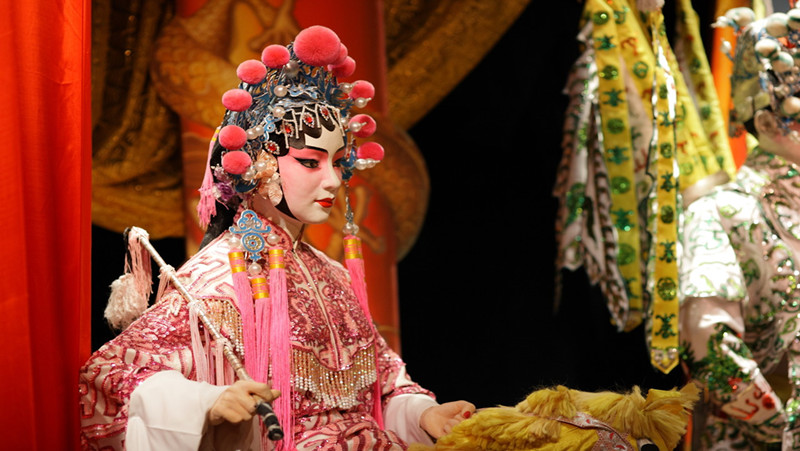
Beijing Opera has had many names since its inception. They are Luantan, Huangdiao, Jinghuang, Jing'erhuang, Pihuang, Erhuang, Daxi (Big Opera), Pingju (Beiping Opera), Jiuju (Old Opera), Guoju (National Opera), Peking Opera, Beijing Opera, etc.
In the 55th year of the reign of Emperor Qianlong in the Qing Dynasty (1790), the famous Hui Opera troupe "Sanqing Ban" in the south of the Yangtze River came to Beijing to celebrate the 80th birthday of Emperor Qianlong. In the early Qing Dynasty, the Hui Opera troupes were very popular in southern China.
After 1828, a batch of Han Opera performers arrived in Beijing one after another. Han Opera, previously known as Chu Tone or Han Tone, is a local opera popular in Hubei province. It has two main melodies, Xipi and Erhuang, with particular emphasis on Xipi. Due to the similarity in melody and performance, most of the Han Opera performers performed jointly with the Hui Opera troupes after arriving in Beijing, and some of them even became the main performers of the Hui Opera troupes, such as Yu Sansheng (known as one of the best Qing Dynasty laosheng players).
The melodies of Hui Opera are mainly Erhuang, Gaobozi, Chuiqiang, Siping, etc., coupled occasionally with Xipi, Kun Opera and Yiqiang. The Han Opera performers mainly play Xipi and Erhuang. After a period of cooperation between Hui Opera and Han Opera troupes, the characteristics of the two gradually merged, accompanied by the influence of the Beijing accent as well as the borrowing of Kun Opera, Yiqiang, and Qinqiang. All these factors eventually led to the formation of a new type of opera, Beijing Opera.
Around 1840, the first generation of recognized and mature Beijing opera performers emerged. It took about 150 years for Beijing Opera to take shape.
(Source: beijing.gov.cn)