2026 Beijing Forum on Swift Response to Public Complaints Opens

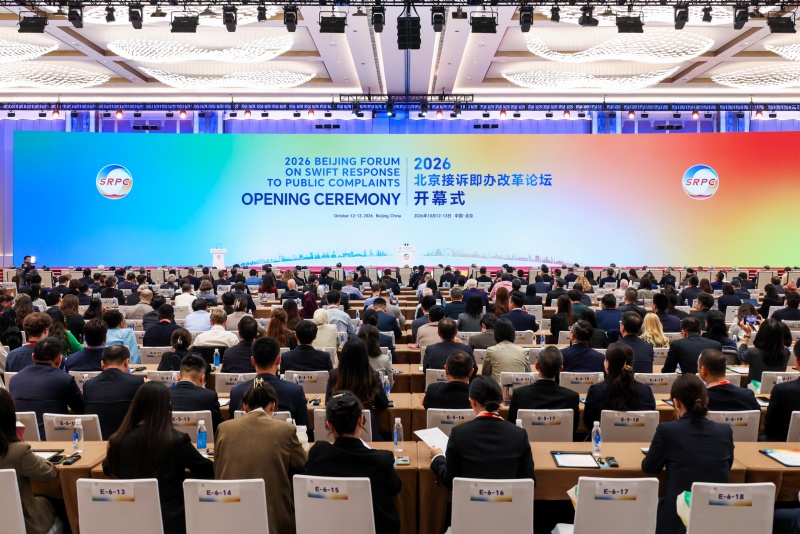
[Photo via 2026 Beijing Forumon Swift Responseto Public Complaints]
On October 12, the 2026 Beijing Forum on Swift Response to Public Complaints opened at the China National Convention Center in Beijing. The permanent theme of the forum is "People's City, Better Future", and the 2026 annual theme is "Digital Intelligent Era and People's City".
The forum consists of an opening ceremony and main forum, six parallel forums, four salons, and a closing ceremony. It also screened "Hotline Beijing 2", a documentary film focusing on the "Swift Response to Public Complaints" (SRPC) mechanism, and held supporting activities such as "Visit to the 12345 Hotline" and city tours.
The forum received widespread attention from all sectors of society, with enthusiastic guest participation. More than 3,200 participants attended, including over 240 international guests from more than 70 countries. Compared with previous editions, the scale and stature of guests were greater, and the forum was more international and professional.
At the opening ceremony, important guests from around the world delivered excellent speeches, including Shen Haixiong, vice minister of the Publicity Department of the CPC Central Committee and president and editor-in-chief of China Media Group; Gao Xiang, president of the Chinese Academy of Social Sciences (CASS); Anacláudia Marinheiro Centeno Rossbach, UN Under-Secretary-General and executive director of the United Nations Human Settlements Programme; Luis Vassy, president of Sciences Po (Paris Institute of Political Studies), France; and Georgios Giannaros, vice mayor of Athens, Greece. A total of more than 850 people attended, including relevant leaders from central departments and Beijing Municipality, Chinese and foreign guests, representatives from Hong Kong SAR, Macao SAR and the Taiwan region of China, heads of sister cities of Beijing, university experts, media representatives, grassroots representatives, and representatives of the public and enterprises. Among them were more than 200 international guests, including representatives of international organizations, diplomatic envoys, sister cities, international academic journals, international business associations, foreign-funded enterprises, and international friends.
A series of outcomes were released at the opening ceremony.
The Compilation of Research Papers on Swift Response to Public Complaints Reform in Beijing (2026) brings together major academic papers by renowned scholars from around the world, including Zhang Yi, director of the Institute of Capital Governance at CASS and a CASS Academic Division Member; Omar Razzaz, a senior fellow at the Harvard Kennedy School; and Tony Prosser, professor at the University of Bristol in the United Kingdom. It includes 12 papers in Chinese and 9 in English.
The first English-language monograph on SRPC How Urban Governance Works? The Case of Swift Response to Public Complaints in Beijing was jointly published by China Social Sciences Press and Springer, an internationally authoritative academic publishing group. It contains 12 papers and brings together research findings from more than 10 renowned scholars from universities from around the world, including CASS, Peking University, Tsinghua University, Renmin University of China, and Harvard University.
The first English-language special issue on SRPC, jointly launched with a leading international journal, was published by the School of Public Policy & Management at Tsinghua University in cooperation with the Journal of Comparative Policy Analysis: Research and Practice (JCPA), a top academic journal in the field of international comparative policy research. It includes five papers and one introduction by renowned scholars from universities from around the world, including the United States, Canada, as well as Tsinghua University and Fudan University. This is the first time that English-language theoretical research papers on SRPC have been published collectively in a top-tier international academic journal.
The Evaluation Report on Worldwide City Hotline Services and Governance Effectiveness and the Report on National 12345 Hotline Services and Governance Effectiveness Evaluation were released. They were produced by experts from Tsinghua University in collaboration with the University of Cambridge, Peking University, and other universities from around the world, evaluating 20 international cities and 100 domestic cities. The evaluation of international cities covered five continents for the first time, and the evaluation of domestic cities took into account city types, geographical distribution, and development foundations.
The Cases of Global Urban Governance Innovation was compiled by experts from Renmin University of China in collaboration with Harvard University, Stanford University, Oxford University, and other universities from around the world, including 21 Chinese cases and 22 international cases. These outcomes further advanced Beijing's SRPC reform from experience summarization to theoretical exposition and from Chinese practice to international comparison, providing practical experience and theoretical support for global urban governance.
At the main forum, keynote speeches were delivered by important guests from both theoretical and practical fields. They included Jiang Xiaojuan, director of the Academic Advisory Committee of the Chinese Public Administration Society, and former deputy secretary-general of the State Council; Navid Hanif, assistant secretary-general for Economic Development in the United Nations Department of Economic and Social Affairs; Anna Matelskaya, head of the Minsk City Executive Committee, Belarus; He Guangcai, Party Secretary of Peking University; Cindy Fan, vice provost for international studies and global engagement as well as professor of geography at the University of California, Los Angeles; Weiping Wu, professor, vice provost for academic programs, and director of the Urban Planning Program at Columbia University; Ottón Solís, former congressman and former minister of Planning and Economic Policy, and former special advisor to the president of Costa Rica; Xiang Botao, executive deputy secretary of the CPC Tsinghua University Committee; Lauren Andres, vice provost of University College London (UCL); Mariafrancesca Sicilia, deputy rector for research, University of Bergamo, Italy, and associate editor of Public Management Review; and Zhu Xinkai, executive vice president of Renmin University of China. Chinese and international guests discussed urban governance modernization, exchanged cutting-edge views, learned from each other, and jointly explored development paths.
Since 2019, Beijing, adhering to the people's city philosophy, has been using the 12345 Citizen Service Hotline as the main channel to innovatively carry out the Party-building-led SRPC reform. It has established a people-serving mechanism featuring rapid response, efficient processing, timely feedback, and proactive governance for citizen demands, blazing a new path for megacity governance featuring active response to residents' demands. Over more than seven years, approximately 200 million cases have been handled, with both the resolution rate and satisfaction rate exceeding 97%. To promote and explain the values of SRPC and strengthen international exchanges and mutual learning in urban governance, the forum, positioned as a governance-oriented, academic, and international forum, is held every two years. It tells the vivid story of "China's governance" to the world and has become one of Beijing's important open exchange platforms.
It was learned that the forum was co-hosted by the Chinese Academy of Social Sciences, China Media Group, the CPC Beijing Municipal Committee, and the People's Government of Beijing Municipality. To strengthen academic research and international communication, the United Nations Human Settlements Programme and the United Kingdom's JCPA were invited as forum partners.