
Beijing Tackles Pollen Season by Spraying Trees and Using Fixatives

Due to the impact of the relatively warm winter, this year's pollen season in Beijing has arrived about five days earlier than usual and is expected to peak in mid-March. At present, pollen control is already underway at many of the city's municipal parks.
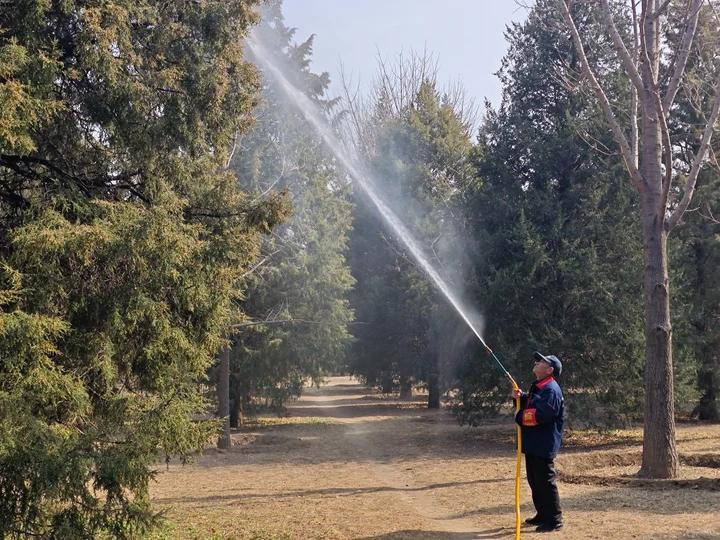
A staff worker sprays cypress trees inside the Temple of Heaven Park to reduce pollen.
[Photo via the Temple of Heaven Park]
The Temple of Heaven Park has sprayed and pruned 10,000 cypress trees. Targeting the sources of pollen, the park's staff workers have been pruning these cypress trees to decrease the number of flower buds to reduce possible pollen. During periods with fewer visitors and higher pollen concentrations, landscaping and cleaning teams are deployed to spray the cypress trees along main roads with high-pressure water, promptly washing pollen from the branches. For the non-opening hours each day, ground sweeping and dampening operations have been intensified. The park's lawn micro-sprinkler systems are also being fully used to increase air humidity while stopping pollen from floating or spreading.
In collaboration with the China Agricultural University and the Beijing University of Agriculture, the Temple of Heaven Park is also testing natural polymer-based pollen fixatives to assess their effectiveness in fixing, delaying, and settling pollen. Comparative experiments are being conducted on new pollen inhibitors and fixatives to determine the optimal measures for using such substances. The goal is to establish a safe, practical prevention and control technology system.
The staff workers of the Summer Palace focus on pruning male cones of cypress trees in the early stage of pollen dispersal. To date, more than 300 cypress trees have been pruned, significantly reducing the initial amount of pollen released. For peak pollen and catkin periods, a zone and grade-based approach utilizing sprinkler irrigation and high-pressure water guns is implemented for tree washing and dust reduction. Now, water spraying has already begun in key areas.
Prior to the start of the pollen season, the staff workers of Zhongshan Park conducted daily dynamic monitoring of wind-pollinated plants such as Chinese junipers to track their growth status in real-time. For periods of high pollen concentration, workers are assigned to spray and rinse key areas no fewer than five times a day, in places such as pathways. Ground dampening and sweeping have also been intensified to reduce re-dispersal from the ground.
Beijing's pollen season is generally divided into spring and summer-autumn periods. The main allergens originate from plant families including Ulmaceae (elm), Cupressaceae (cypress), Salicaceae (poplar, willow), Pinaceae (pine), Cannabaceae (Japanese hop), Asteraceae (Artemisia), and Chenopodiaceae.
So, what should those allergic to pollen do?
Before Going Out:
1. Check real-time pollen levels via the "Pollen Detection and Forecast" (花粉检测预报) section of the "Jingtong" (京通) mini-program.
2. Pay attention to information on wind, humidity, and precipitation. On sunny, dry days with light wind, pollen concentration levels are relatively high, so minimize trips if possible. On days with obvious rainfall or winds stronger than force 4, pollen concentration decreases.
3. Avoid going out during the peak pollen concentration periods (10:00–17:00 daily).
4. Wear a protective mask and goggles to prevent pollen from entering your eyes, nose and mouth.
After Returning Home:
1. Remove outer clothing promptly and clean your face, eyes, nose, and other areas where pollen may easily accumulate.
2. Open windows as little as possible and avoid drying clothes or bedding outdoors to prevent pollen from sticking to them.
3. For severe allergic symptoms, use pollen barrier sprays or take medicine under medical guidance.
(Sources: Beijing Daily, The Beijing News)