Tackling Last-Mile Challenges: Beijing Public Transport Corporation Continues to Enhance Everyday Services

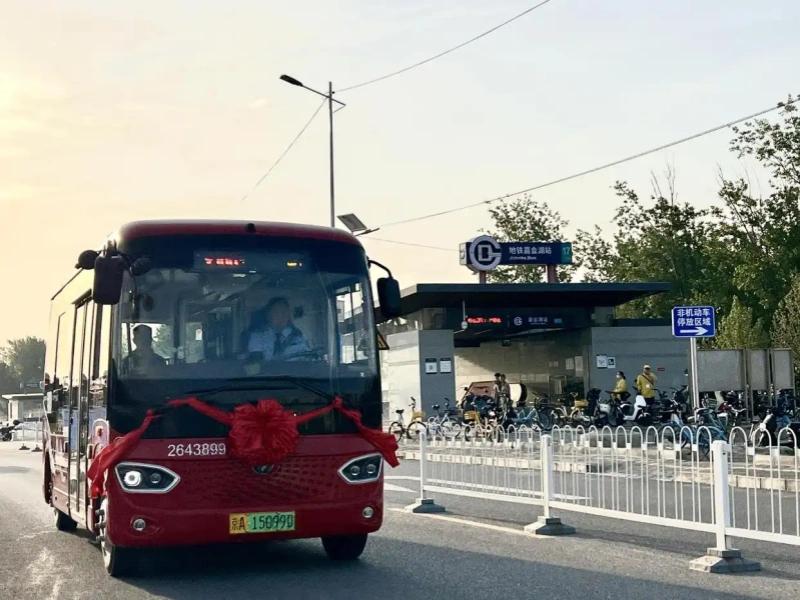
During the 14th Five-Year Plan period (2021–2025), the Beijing Public Transport Corporation focused on enhancing services for residents by launching school shuttle routes, increasing short-distance routes with high service frequency and rapid vehicle turnaround, and exploring staggered shared parking. These efforts aimed to tackle the last-mile challenges in public transport services.
Over the past five years, the city has optimized bus routes and stop locations to facilitate smoother transfers between buses and rail transit. Over 600 bus routes have been optimized, with the surface bus network expanded by over 500 kilometers, improving travel convenience for residents in 899 residential communities. The rate of bus-subway transfers within 50 meters has increased to 90 percent. Meanwhile, the corporation has upgraded stop announcement equipment and route maps, and conducted transfer training for drivers and onboard staff across 450 bus routes, which reach 50 subway stations, all aimed at providing faster, more convenient transfers for commuters.
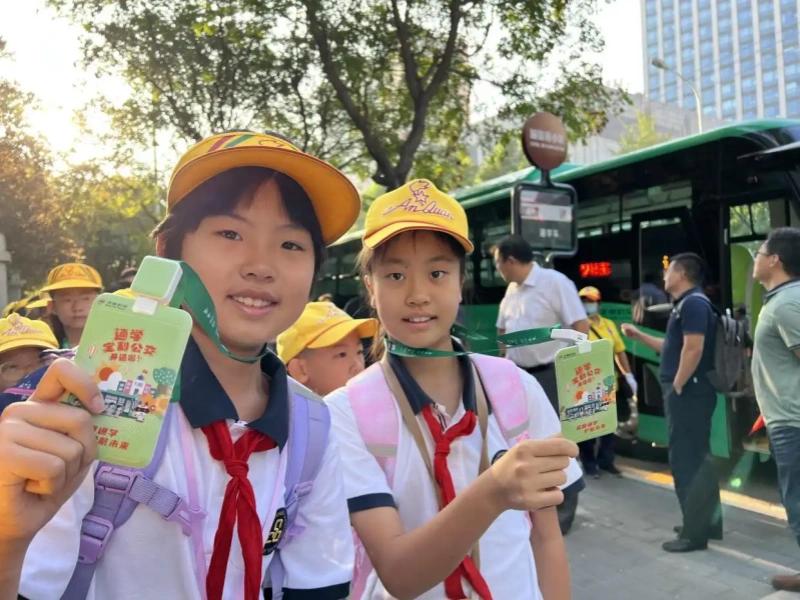
Young passengers using a school shuttle bus
Focusing on key areas of public demand—schooling, medical care, tourism, and consumption, the corporation has developed over 350 diversified shuttle services branded with "Tong" (通). Among them, the "Tong Xue" (通学) school shuttle network has been expanded significantly, growing from 25 routes serving 13 schools in four districts to 299 routes serving 120 schools in eight districts, with the number of students served skyrocketing from 900 to 18,500. To improve access to healthcare services, 14 "Tong Yi" (通医) shuttle routes have been launched to take passengers to 17 hospitals, with an average of 2,500 passenger trips daily. Meanwhile, 39 "Tong You" (通游) shuttle routes for tourists have been introduced to provide convenient access to over 50 popular attractions, such as the Beijing Performing Arts Center, the Beijing Library, and the Grand Canal Museum of Beijing, recording over 20,000 passenger trips per day on holidays.
The corporation has also designed 208 iconic bus routes to continuously enrich the cultural experiences on board. Among them, routes No. 82, No. 5, No. 2 and several other routes, which connect important heritage sites and other attractions along the Beijing Central Axis (including the Beijing Olympic Park, the Drum Tower, and Yongdingmen Gate), form the centerpiece of the "Guarding the Central Axis" cultural bus routes, carrying forward the city's historical legacies. In addition, routes such as No. 107 (which traverses the ancient capital's cultural landmarks and old streets around the Drum Tower rich in Beijing's local cultural elements), No. 141 (which runs north-south across the city), No. 23 (which dates back to 1949, the same year when the People's Republic of China was founded), and T116 (which is dedicated to promoting the Grand Canal culture), all carry the memories of Beijing as a historic capital. These routes highlight Beijing's characteristics, invite passengers to experience its time-honored appeal, and showcase the spirit of the times.
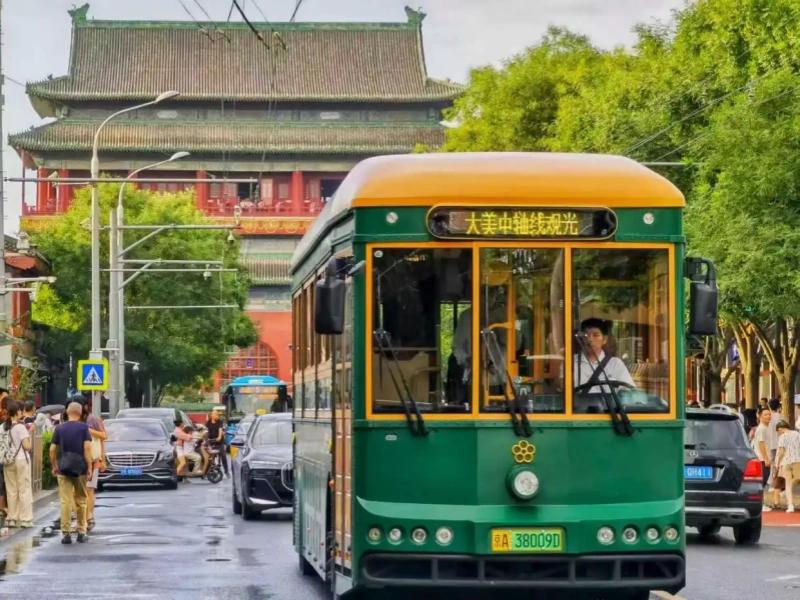
"Grand Central Axis" sightseeing bus
Following the successful inscription of the Beijing Central Axis as a World Heritage site, the corporation launched the "Grand Central Axis" sightseeing bus route. In its first year of operation, the route recorded nearly 100,000 trips by passengers nationwide and attracted nearly 1,000 foreign guests. Plans are underway to introduce multilingual translation services to help global audiences better appreciate the cultural charm of the Beijing Central Axis.
Enhancing senior-friendly facilities and accessibility has remained a priority in the corporation's service improvement efforts. Over the past five years, the corporation has enlarged its fleet of low-floor, accessible vehicles, with barrier-free public electric buses in urban areas now accounting for 80 percent. It has also created 130 senior-friendly bus routes and added a barrier-free passenger guidance system to the "Yilutongxing" (一路同行) app, making it easier for people with disabilities to plan their journeys.
Currently, the corporation has opened over 200 bus terminals with staggered shared parking facilities to the public, providing over 3,000 parking spaces for private vehicles.
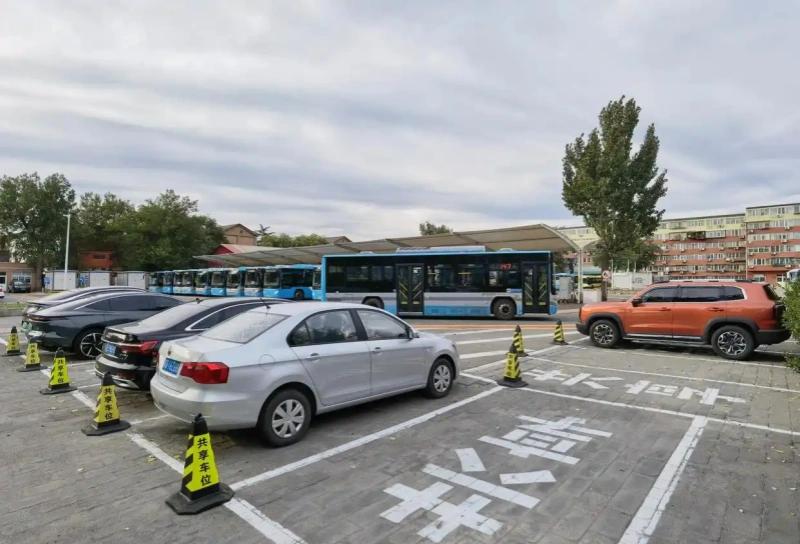
Staggered shared parking spaces of Tiancun Banbidian Bus Terminal
In addition, Beijing's public transport fleet has undergone continuous optimization. As of now, a total of 20,547 public electric buses are in operation, with clean and new energy buses accounting for nearly 94.4 percent, making Beijing home to the world's largest clean energy bus fleet. As part of the 2022 Winter Olympics' green legacies, 169 hydrogen fuel-cell buses have been integrated into the city's regular public transport fleet.
(Source: Beijing Daily App)