Beijing Unveils General Whole-Body Control Model, Advancing Humanoid Robots Toward Real-World Operations

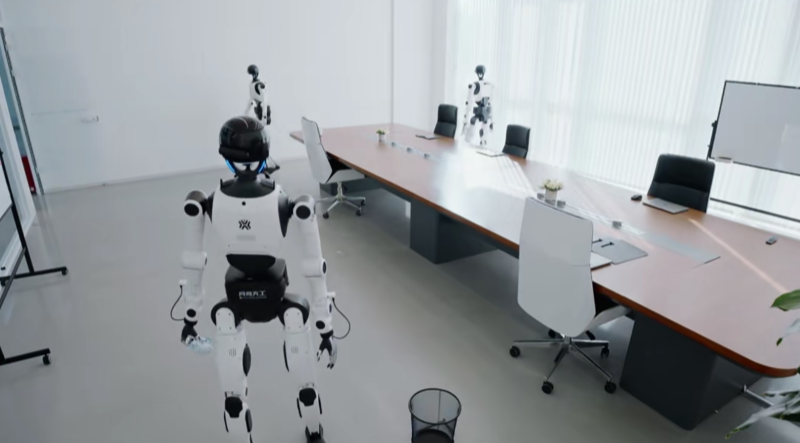
On November 2, the Beijing Innovation Center of Humanoid Robotics (X-Humanoid) officially released Hi-WBC (Whole-Body Control for Humanoid Intelligence) via its "Wise Kaiwu" embodied AI platform. By coupling human motion references with real-world physical constraints, the model enables robots to precisely track motion intent while dynamically adapting execution to changes in payload, external forces, and terrain. This delivers a new paradigm for robotic operations in high-risk and specialized environments.
While motion imitation allows robots to rapidly acquire human-like motor skills, deploying them in real-world tasks demands handling payload variations, contact forces, and terrain constraints. The core philosophy of Hi-WBC is to transform motion references from a "final answer" that must be rigidly replicated into a "motion prior" that guides whole-body movement. While preserving motion-following fidelity, the framework adjusts posture, joint kinematics, and support relationships based on dynamics and environmental constraints — establishing a control strategy that seamlessly balances rigidity and flexibility.
For continual evolution and skill expansion, Hi-WBC adopts a framework powered by Mixture-of-Experts (MoE) and policy distillation. Grounded in a general-purpose locomotion policy, it introduces dedicated expert policies for specialized tasks and subsequently distills these capabilities back into the general-purpose model. This allows specialized breakthroughs to be internalized into general capabilities, empowering humanoid robots to move beyond mastering individual movements and take on a wider range of tasks.
To tackle strong physical interaction and heavy payloads, the model leverages contact-aware learning. By estimating external forces through proprioceptive signals such as joint currents and kinematic states, combined with short-horizon dynamics optimization, Hi-WBC coordinates posture and contact support. Through reinforcement learning, it jointly optimizes motion tracking, balance stability, and task execution — enabling robots to lift heavy loads, push steadily, and seamlessly recover from external disturbances.
In complex terrains and autonomous adaptation, Hi-WBC introduces perceptive control, integrating terrain awareness into whole-body control. It identifies feasible contact regions and dynamically adjusts foot placement, swing-leg trajectories, and support-phase transitions. This ensures that movement intent guides the action, while terrain conditions determine how it is executed, extending robotic locomotion across slopes, stairs, and obstacle-laden environments.
Looking ahead, X-Humanoid will advance its roadmap toward self-evolving motion-control agents. Leveraging the "Wise Kaiwu" platform, it will bridge Hi-WBC's whole-body control capabilities with real-time sensory feedback and real-robot learning. This will empower robots to adapt dynamically on-site and turn interaction experiences into insights for policy improvement, driving continuous advances in motion control. The goal is to move whole-body control beyond staged demonstrations and into practical deployment, and from specialized skills towards general-purpose locomotion and manipulation.
(Source: Beijing Innovation Center of Humanoid Robotics)