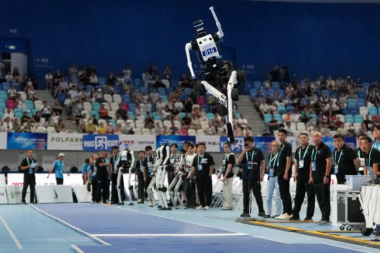
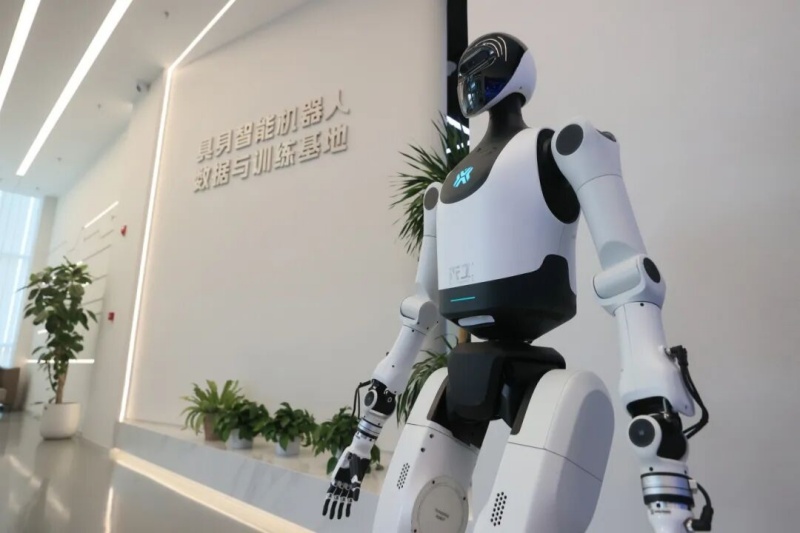
The 2nd World Humanoid Robot Games concluded at the National Speed Skating Oval (also known as the "Ice Ribbon") on August 26. A number of teams set new competition records in the track and field events, showcasing advances in the athletic capabilities of humanoid robots. The Games also featured competitions across nine real-world application scenarios, including household tasks, industrial operations and emergency rescue, highlighting robots' growing potential for practical use.
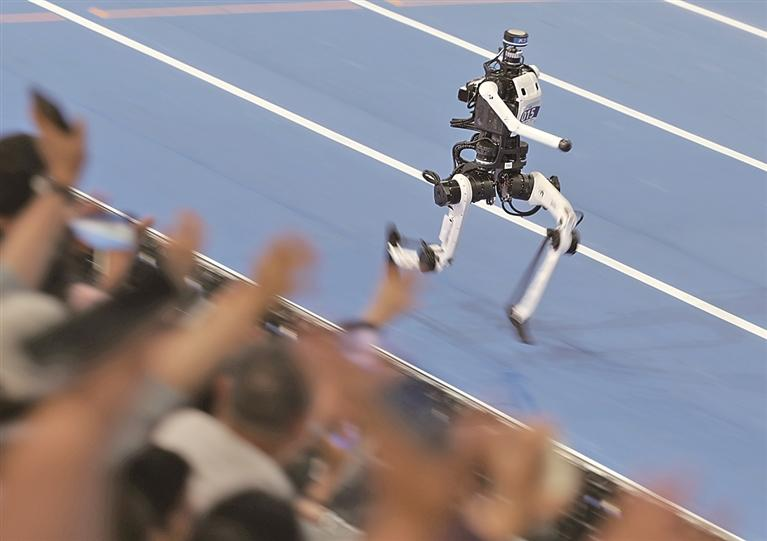
On August 23, Tianzhuo Team won first place in the 1,500m final at the 2nd World Humanoid Robot Games. The photo shows the Tianzhuo robot during the race.
[Photo by Zhang Chenlin from Xinhua News Agency]
In the small-group 400m race, Tiangong Omni, developed by the Beijing Innovation Center of Humanoid Robotics, crossed the finish line first in 45.66 seconds. In the 1,500m event, Tianzhuo Team claimed the title with a time of 2 minutes 21.64 seconds, a significant improvement on the previous Games' winning time of 6 minutes 34.40 seconds and faster than the 3-minute-26-second human record.
In the 100m finals, Tianjiao Team's humanoid robot won the large-group title in 8.64 seconds, while Tianxiao Team took the small-group title with a time of 11.98 seconds. These significant record-breaking performances reflect the rapid development of China's robotics technology in recent years, with such advances expected to support wider applications across different industries.
In the scenario-based events, the participating robots also demonstrated increasingly practical capabilities. In the "Smart Charging Service" challenge, for example, the robots were required to complete the entire process of unplugging charging connectors, charging and returning the connectors to their original positions for three vehicles within 30 minutes. In the "General Service" competition, many robots were able to autonomously arrange nameplates, print documents and shred paper.
Beyond advances in competitive performances and practical applications, the Games also showcased a blend of technology and culture both inside and outside the venue. More than 100 robot-themed creative cultural products were introduced, including pendants of "Zhibao" (the mascot), the "Ice Ribbon" ornaments, and floating badges. Sales at the on-site souvenir store exceeded 200,000 yuan on the opening day. Outside the venue, the "Hi FUN" robot-themed leisure market opened within the Ice Ribbon complex, featuring 70 stalls, including 28 where robots themselves served as vendors.
Champion robots and some of the most popular competitors from this year's Games are also expected to make pop-up appearances in neighborhoods across the city.
(Source: Guangming Daily)