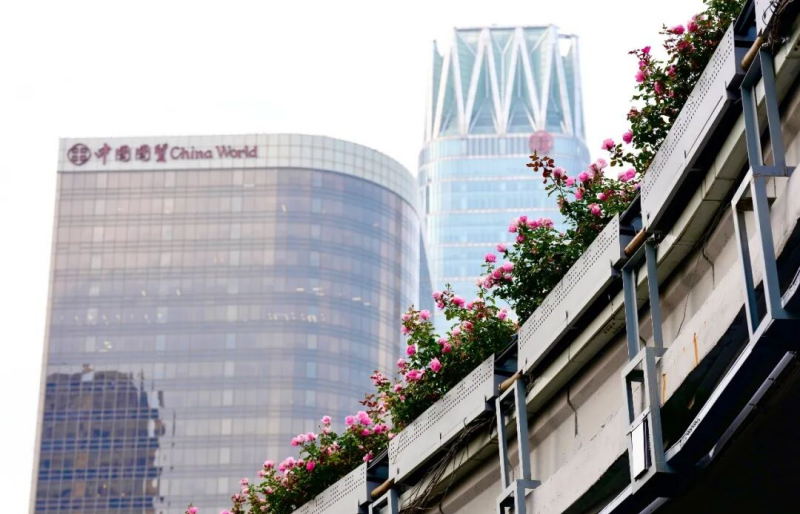
As autumn brings crisp air and clear skies, Chinese roses along Beijing's ring roads burst into bloom once again. Having gone viral this spring, these blossoms are brightening roads across the city. Especially at bridges and interchanges in areas such as Guomao, Sihui and Sihai, the Beijing-bred floribunda "Yueding" is in full bloom. Each stem of this cultivar can produce 15 to 20 flowers, making the cultivar suitable for vertical planting along ring roads and in bridge zones.
Given the heavy traffic on the ring roads, the roses are maintained using smart irrigation systems. Take the Muxidi Bridge project as an example. The IoT-powered irrigation system can monitor soil moisture and automatically supply additional water when needed. During the peak growing season from May to September, smart irrigation saves an average of around 65 percent of water per day, greatly reducing the frequency of water truck visits and manual maintenance work on bridges. As part of the ongoing renovation project of the 4th Ring Road, 500,000 meters of new irrigation pipelines are being installed along the route. Multiple smart irrigation modes will gradually be put into operation, enabling intelligent maintenance of the flowers.
Chinese rose belts along the city's main roads now extend for more than 300 kilometers. Including secondary and branch roads, the total length of flower belts approaches 1,000 kilometers.
It is worth noting that the 4th Ring Road will feature a spectacular, continuous ring of Chinese roses next spring. The 4th Ring Road Urban Flower Ring Project is in progress, with the full loop expected to be completed in November and an estimated total of 713,000 Chinese rose plants to be planted. The flower belt along the central divider has now been completed, while construction on flower belts along service roads and between the main carriageways and service roads is underway.
(Source: Beijing Fabu)