
Beijing Launches First 'Jingdong' E-commerce Container Train: A New Logistics Link Connecting Beijing-Tianjin-Hebei and Greater Bay Area

On August 14, a container train loaded with various e-commerce goods from JD Logistics departed smoothly from Dahongmen Freight Yard of China Railway Beijing Group. This marks the official launch of the "Jingdong" e-commerce container train running between the Beijing-Tianjin-Hebei region and the Guangdong-Hong Kong-Macao Greater Bay Area. The containers hold more than 100 tons of e-commerce goods from JD Logistics, including home appliances, daily necessities and other commodities.

The Beijing-Tianjin-Hebei region boasts a high concentration of e-commerce entities and vibrant market activities, serving as a key distribution hub for e-commerce supplies in northern China. Every day, large volumes of goods, such as daily supplies, home appliances, mother and child products, cosmetics, and digital devices, are shipped to major cities and regions in the Guangdong-Hong Kong-Macao Greater Bay Area, including Foshan, Dongguan, and Zengcheng District of Guangzhou in Guangdong Province.
For a long time, e-commerce goods have mainly been transported via long-distance highways. Compared with road transportation, railway freight is less affected by extreme weather and congestion, marked by greater resistance to disruption, more reliable delivery schedules, higher punctuality rates, larger freight capacity and lower transportation costs.
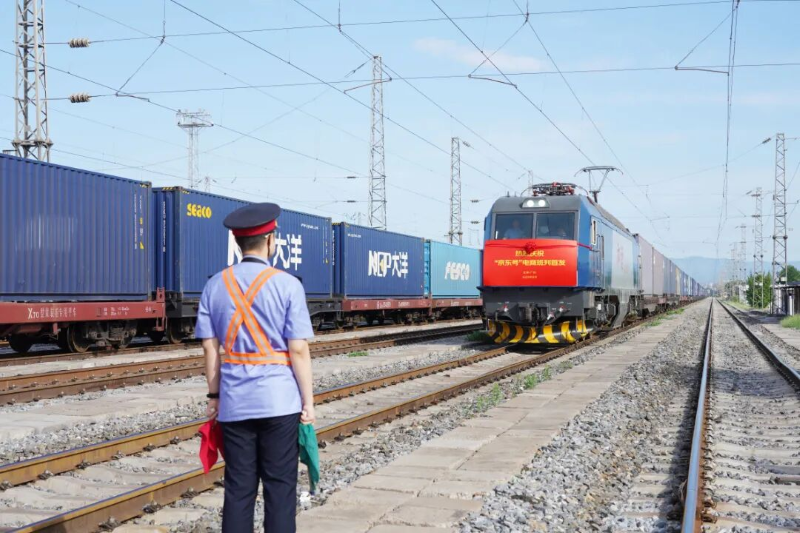
In terms of transportationroperations, the two major freight yards, Dahongmen and Guangyang, operate together to fully tap the potential of railway transportation. Guangyang Freight Yard maintains its original freight scheme, while dedicated spaces for the e-commerce cargo of JD Logistics have been set up at Dahongmen Freight Yard. Transportation capacity is allocated dynamically according to fluctuations in market cargo supply to realize efficient circulation, with cargo collected, loaded, and dispatched promptly upon arrival. All wagons are marshalled at the Fengtai West Railway Station and operations are done under standardized and efficient procedures, thereby ensuring safe and controllable transportation throughout the whole journey.
The train runs on a regular timetable with five morning departures every week from Wednesday to Sunday, running nonstop to Dalang Freight Yard in the Guangdong-Hong Kong-Macao Greater Bay Area, from where the cargo will be distributed to dedicated warehouses.
The one-stop multimodal transportation service creates a direct link between the e-commerce supply bases in the Beijing-Tianjin-Hebei region and the consumer market in southern China. The regular operation of this train also accelerates the shift of freight transportation from road to rail and supports the development of green and low-carbon logistics.
(Source: China Railway Beijing Group)