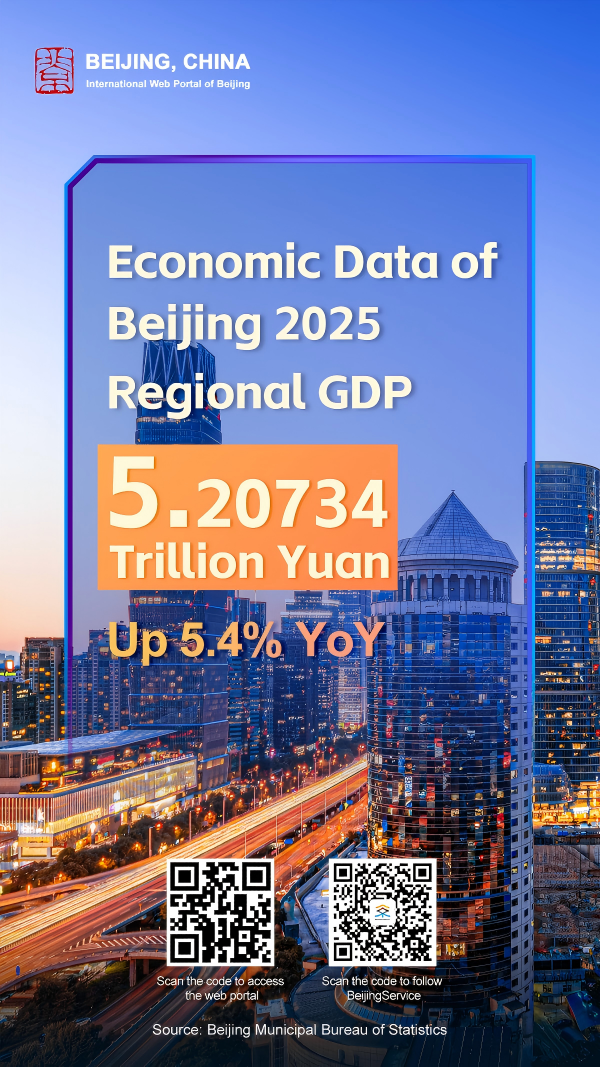


The year 2025 marked the final year of China's 14th Five-Year Plan period. Over the year, Beijing recorded a GDP of 5.2 trillion yuan, representing a growth rate of 5.4 percent, 0.4 percentage points higher than the national average. The city's general public budget revenue increased by 4.8 percent, the surveyed unemployment rate in urban areas stood at 4.1 percent, and residents' per capita disposable income saw a real growth of 4.4 percent. These are just part of the positive data in Beijing's government work report, which evidences that the city largely fulfilled its targets set for 2025.
• The value of contracted technology transactions from Beijing to Tianjin and Hebei reached 99.6 billion yuan, up 18.1 percent.
•Breakthroughs were achieved in 36 bottlenecks in the biopharmaceutical and other key industrial chains.
• Permanent zones of three national laboratories became operational, and three interdisciplinary research platforms commenced trial operations.
• Breakthroughs were achieved in a total of 210 core technologies.
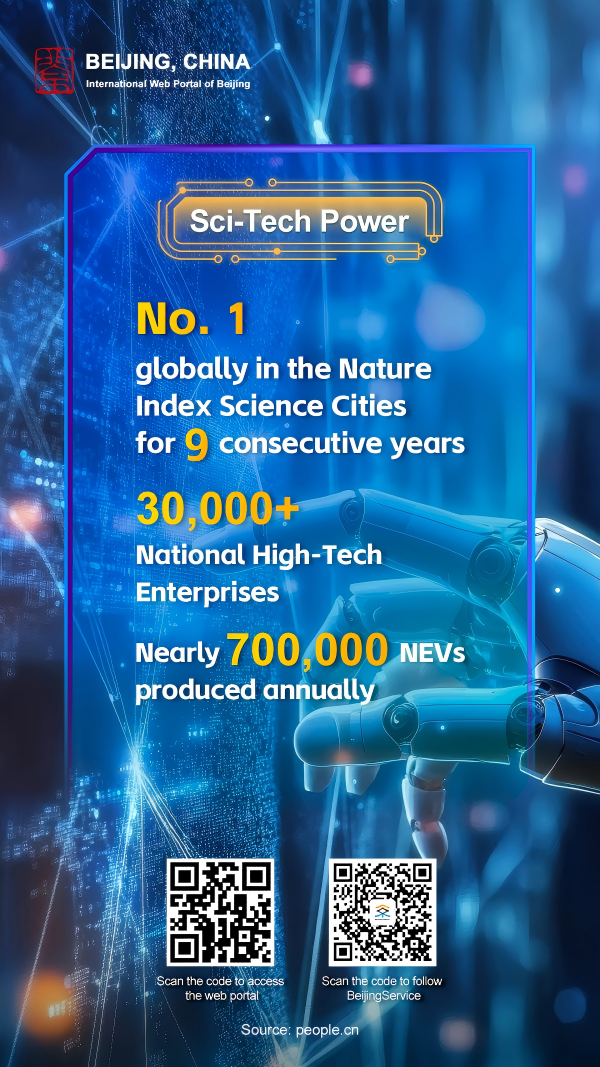
• Beijing topped the Nature Index Science Cities ranking for nine consecutive years.
• The integrated circuit industry grew by over 20 percent, and the annual production of new energy vehicles approached 700,000 units.
• The number of national high-tech enterprises in the city surpassed 30,000.
• The added value of the digital economy increased by 8.7 percent.
• The number of companies listed on the Beijing Stock Exchange reached 288, with a total market capitalization exceeding 860 billion yuan.
• A total of 35 national-level major funds were launched, and eight municipal-level funds for high-end, sophisticated and cutting-edge industries attracted over 100 billion yuan in social investment.
• A total of 119 key "All-in-One-Go" government services were introduced, reducing average processing time by 58 percent and required documents by 52 percent.
• The tasks (phase 2.0) for expanding the opening up of the services sector were largely completed, with Beijing ranking first in the national comprehensive evaluation for four consecutive years.
• The number of newly established foreign-invested enterprises grew by 19.5 percent, and Beijing’s total export value reached a record high.
• Inbound tourist arrivals increased by 39 percent, contributing to record highs in tourist visits and tourism revenue citywide.
• Service consumption rose by 5 percent.
• The number of new energy vehicles on the road exceeded 1.3 million, and green electricity accounted for 36 percent of total power consumed.
• The proportion of days with good/moderate air quality exceeded 80 percent for the first time, while the average annual concentration of fine particulate matter (PM2.5) fell to 27 micrograms per cubic meter, down 11.5 percent.
• The proportion of Beijing's water body cross-sections rated as good/excellent in the national surface water assessment remained stable at over 90 percent.
• An additional 1,000 kilometers of greenways were constructed.
• Three new subway lines were opened, extending the network by 30 kilometers. The total length of Beijing's rail transit system reached 909 kilometers, ranking first nationwide.
• A total of 242 bus routes were optimized, with 91 percent of bus-to-rail transfers achieved within a 50-meter walking distance.
• Over 50,000 new parking spaces for motor vehicles were added in the central area.
• A total of 2,295 sessions of large-scale events were held, up 25.8 percent, and 16,000 sessions of public cultural events were organized.
• A total of 198 high-quality sports events, such as the World Table Tennis (WTT) China Smash, were both well-received and commercially successful.
• The resolution rate and satisfaction rate for requests and complaints handled through the citizen service hotline reached 97.3 percent and 97.7 percent, respectively.
Beijing is steadily turning public expectations into visible and measurable outcomes.
(Source: people.cn)