

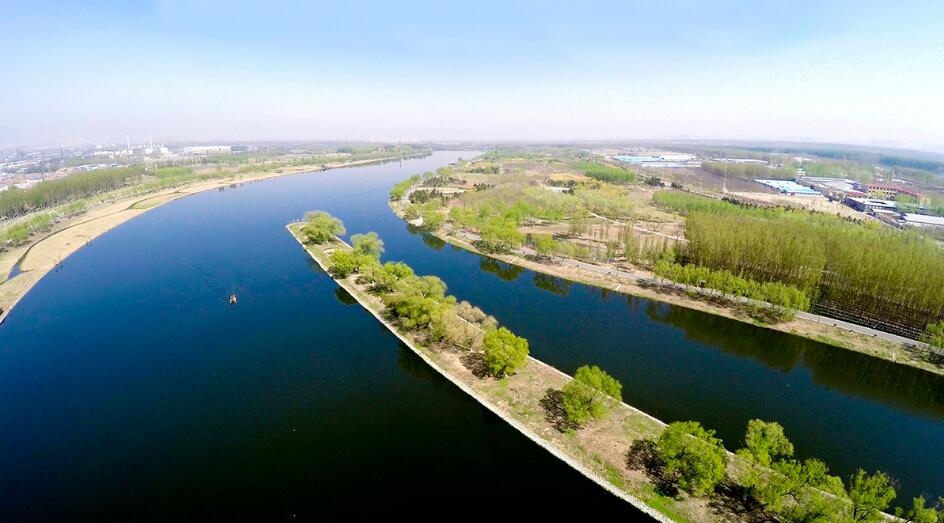
Tongzhou Canal Park
Tongzhou lies in the southeast of Beijing and the north end of The Beijing-Hangzhou Grand Canal, covering an area of 906 square kilometers. As the capital's sub-center, Tongzhou is featured by its global vision, international standard, Chinese traits and high expectation for itself. At the same time, the district is poised to build itself into Beijing's sub-center in the spirit of creating history and pursuing art, and forging ahead the task with the most progressive ideas in the highest standards and the best quality. The district will spare no efforts to build a world-class demonstration area for harmonious and livable conditions, new-type urbanization and Beijing-Tianjin-Hebei coordinated development.
Tongzhou enjoys profound historical and cultural foundation. Tongzhou has a history of over 2,200 years and profound canal culture, making it a shining pearl along the Beijing-Hangzhou Grand Canal. Ever since ancient times, Tongzhou has been a metropolitan area pooling numerous merchants and talents and being accessible by both land and water. It has also been an important town for commercial and trade activities. Moreover, a number of historic relics and remains, including Randeng Buddha Sheli Tower, Sanjiao Temple, and Daguang Tower, highlight the district's charms in the ancient and modern times.
Tongzhou boasts natural advantages in terms of geographical location. Tongzhou borders Tianjin and Hebei, and is where Beijing-Tianjin development axis and Beijing-Tangshan-Qinhuangdao development axis meet each other inside Beijing. Moreover, it plays a supportive role for Beijing's involvement in Beijing-Tianjin-Hebei coordinated development. Down the road, it'll only take 15 minutes from Tongzhou to Beijing Capital International Airport, 35 minutes to Beijing Daxing International Airport and one hour to Xiong'an New Area.
Tongzhou is a beautiful district with abundant rivers. Tongzhou is a land-locked water district with the largest watershed areas in Beijing, which is rarely seen in northern China. There are altogether 13 rivers, stretching 245.3 kilometers combined. Moreover, Tongzhou takes pride in its 10,000 mu (a unit of area=0.0667 hectares) of forest park, making it a district surrounded by green spaces, blue waters, twittering birds and flower fragrance. Over the years, the district has garnered titles including "National Hygienic District" and "National Civilized Urban District", and it is building itself into a part of the "National Forest City".
Tongzhou is an urban district driven by industry development. There are over 100 square kilometers of industrial parks inside Tongzhou District, creating abundant space for further development. Centering on three major functions, i.e. administrative office, business service and cultural tourism, Tongzhou is building a platform for science & technology innovation, and fostering seven major industry clusters worth hundreds of billions yuan including headquarters economy, wealth management, cultural tourism, cultural science & technology, sophisticated chip business, IT information software and intelligent manufacturing, in a bid to speed up building its portfolio of sophisticated industries.
Visionary construction of “Two Zones”.The development of the "Two Zones" in Tongzhou District designates major demonstrative and functional areas such as the Canal Business District, Cultural Tourism Zone and Zhangjiawan Design Town as the core locations of opening-up. Surrounding the industrial layout of Beijing Municipal Administrative Center, Tongzhou focuses on fields including wealth management, green finance, FinTech, urban planning and design, cultural and creative design, culture and tourism, and professional services. Its functionality also includes exploring reform and innovation, strengthening its services and assurance system, and also deepening the demonstrative coordination among the Beijing-Tianjin-Hebei region. Applying the mode of "opening up of industries and industrial parks", the district strives to deepen its immersion by exploring a full range of more profound assimilative measures with a larger scale and broader fields, so as to make Beijing a new benchmark of greater openness and better development.