

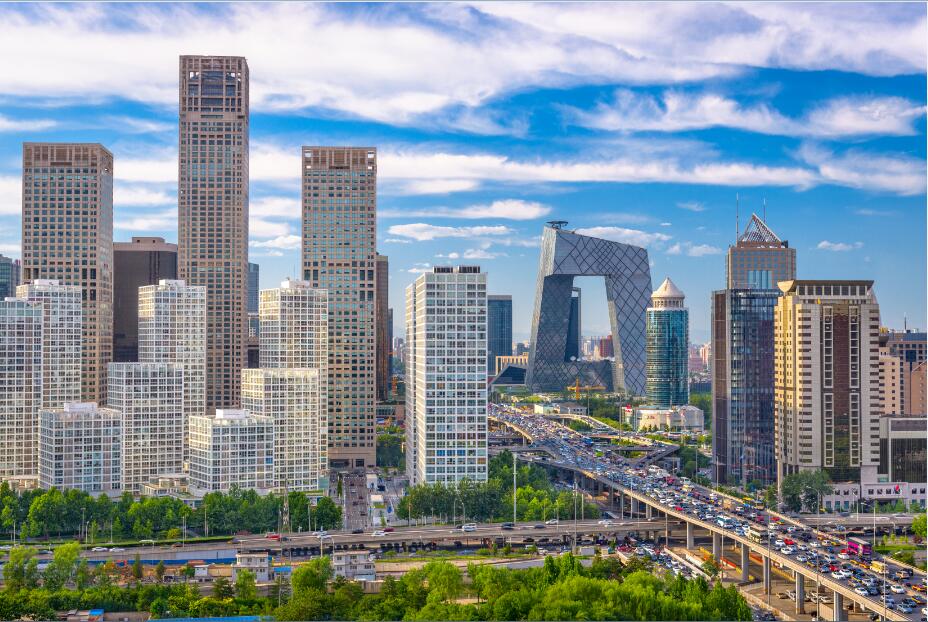
Beijing CBD
Situated in eastern Beijing, Chaoyang District is the largest and the most populous urban area in Beijing, covering a total area of 470.8 square kilometers (accounting for 3% of Beijing). Administering 24 subdistricts, 19 townships (466 communities and 144 villages altogether), it has a permanent population of 3.473 million (accounting for 16.1% of Beijing). The district used to be an important industrial area, and "Vegetable Basket" and "Rice Bag" for Beijing people before the reform and opening-up. Thanks to the rapid development in recent years, Chaoyang has become an economic powerhouse and a significant window for foreign trade in Beijing.
Located in the heart of the city proper, Chaoyang is the epitome of capital function cluster. In the new edition of General City Plan for Beijing, Chaoyang is designated as the central urban area in Beijing. It is positioned as the world-class central business district, international science, technology, culture and sport exchange district, a cluster for a variety of international communities, an innovation-driven cultural front for the capital, a large-scale eco-environment construction and demonstration district, as well as a high-quality urbanization comprehensive reform pilot district. Centered on "culture, international development and large-scale afforestation", Chaoyang strives to be the pioneer in Beijing, promoting high-quality development in all aspects of economic society.
With ideal conditions for modern business, Chaoyang plays a leading part in Beijing's economic development. The district leads others in terms of major indicators all the time. In 2019, GDP, revenues in general public budget, investment and consumption accounted for 21%, 9%, 15% and 24% of Beijing respectively, while foreign investment and trade for 30% and 47% of Beijing respectively. Chaoyang ceaselessly purses optimization of its industrial structure in the domains of business, finance, culture, science and technology. Contributions from the service sector exceeded 93% as here are six out of the ten world's biggest consulting firms, and nearly 40 out of top 100 brands of human resources service organizations. The revenue from financial and cultural sectors in Chaoyang accounted for 16% and 20% of Beijing respectively. Furthermore, 1/3 of the unicorn companies and 15% of the national hi-tech enterprises are all here. A large group of industries have settled down in this district, with 90% of district-wide fiscal revenues coming from three major functional domains, namely, CBD, Zhongguancun Chaoyang Park and Olympic-related facilities. As a leader in business environment, Chaoyang pioneered the corporate-friendly services like policy packages. District-level administrative services can be accepted, processed, and delivered through "One Door, One Window, and One Network", thus creating an “ultra-speed” mode for startups and immovable property registration.
With the convergence of international resources, Chaoyang serves as a window for foreign exchanges. Chaoyang is long known as "The First District for Foreign Exchanges in China" as it is the place with 99% of foreign embassies to China, 80% of international organizations and international chamber of commerce in Beijing, 70% of regional headquarters of multi-national corporations, 65% of foreign capital financial organizations and more than 50% of international-level conferences. Besides, there are a number of landmarks built in different periods, such as Intime Department Store, China World Trade Center Tower III and CITIC Tower, as well as trendy street blocks including Parkview Green, Taikoo Li Sanlitun and The Place, epitomizing the achievements of Beijing as a metropolis. Moreover, as a pilot district in Beijing, Chaoyang launched three rounds of further opening-up of its service sector in a row, making it extremely attractive for foreign investment. As one of the six high-end industrial function zones in Beijing, the CBD plays a vital role in the city's industrial upgrading, cultural exchanges and open innovation. Chaoyang also takes pride in its sound international service functions as it boasts 8 international medical institutions, 16 out of 19 schools for children of foreign personnel in Beijing. Meanwhile, the Wangjing International Talent Community is around the corner and it will contribute to a "quasi overseas" environment in the district once built.
With the accelerated progress of pursuing quality instead of quantity, Chaoyang becomes the pilot area for Beijing's relocation and renovation of urban functions. As of the "Relocation and Renovation for Improvement" special task being carried out in 2017, altogether more than 28 million square meters of land had been demolished and vacated, accounting for 20% of Beijing's total. Moreover, Chaoyang was the first district to adopt localized construction waste recycling in China, capable of handling tens of millions of tons of construction waste per annum. In the process of large-scale urban function relocation, Chaoyang followed international standards and emphasized eco-development and urban fine management. As a result, the PM2.5 concentration index dropped yearly, and sewage treatment rate reached 98.5%, and the 500-meter service radius of park green space coverage reached 92.6%. There are a number of gorgeous urban landscapes in Chaoyang, including Empress Dowager Xiao River Waterfront Green Culture Leisure Corridor, and Olympic Green Light Show, earning Chaoyang the recognition from municipality. It is acknowledged that "when it comes to large-scale green space building, Chaoyang is a paradigm".
Rich in cultural and artistic activities, Chaoyang is beaming with innovation and creativity. Chaoyang enjoys the most colorful cultural resources in China as there are 400 notable media organizations at home and abroad, such as CCTV and Reuters, as well as 80-plus well-known art performance groups like China Oriental Performance Arts Group and China National Symphony Orchestra. As of 2014, centered around CBD-Dingfuzhuang International Media Industry Corridor, Chaoyang has built its first national cultural industry innovation experiment area for policy and service to provide a vivid display of turning old, dilapidated factories into cultural parks. Furthermore, Chaoyang is a demonstration area for national public culture service system. There are 52 museums in the district, taking up 1/4 in Beijing, together with an array of distinctive cultural brands like the 24-hour self-service library, the digital cultural community and the urban bookstore.
With continuous progress made in social development, Chaoyang has become a model for harmonious and livable districts. Since there are diverse demands for Chaoyang's diverse demographic structures, the district speeds up its effort on addressing livelihood issues for residents and catering even closer to the public's need. At present, over 98% of the district has access to quality primary and secondary education resources. Moreover, a number of projects here have become pilot and demonstration ones in Beijing and even the whole China, such as well-equipped medical service network, three-tiered elderly nursing system, public hospital reform, medical treatment alliance and total factor community and Shuangjing "13 Community". Meanwhile, Chaoyang always follows the principle of "responding to people's needs" and handling more than 1,000 livelihood issues of all types annually for people. As a result, Chaoyang people's sense of gain, happiness and security keeps improving.