In 2025, the scale of Beijing's core AI industry reached approximately 450 billion yuan, with more than 2,500 related companies. Both figures accounted for about 40 percent of their respective national totals. As of September 24, 2026, Beijing had completed the filing process for 319 large generative AI models, the highest total in the country.
In the opening year of the 15th Five-Year Plan, Beijing aims to become the "world's leading AI city" and to expand its core AI industry to more than 1 trillion yuan in value within two years.
Beijing E-Town has established the country's first facility for producing embodied AI training data based on real-world environments, covering more than 30 representative scenarios in homes, retail stores, and industrial and pharmaceutical settings. The facility houses over 150 mainstream robots in 40 configurations. With an annual production capacity of 180,000 hours, it has already delivered nearly 30,000 hours of high-quality data. More than 70 percent of its capacity serves leading enterprises and research institutions, and the facility is moving toward its goal of "1 million hours of high-quality data".
At Jinyu Intelligent Smart Manufacturing Factory in Haidian District, the Beijing Shuimu Dongfang Medical Robotic Technology Innovation Center is accelerating the commercialization of research outcomes through a "manufacturing + services" model built around its contract development and manufacturing organization (CDMO) platform for high-end medical equipment.
The platform has handled nearly 600 client engagements, attracted and nurtured more than 50 high-quality medical robotics projects, and helped 22 products obtain the registration certificates of China's National Medical Products Administration (NMPA). It has raised the commercialization rate for projects it supports from the industry average of 10 percent to over 80 percent, reduced R&D costs by more than 60 percent, and cut prototype iteration cycles in half.
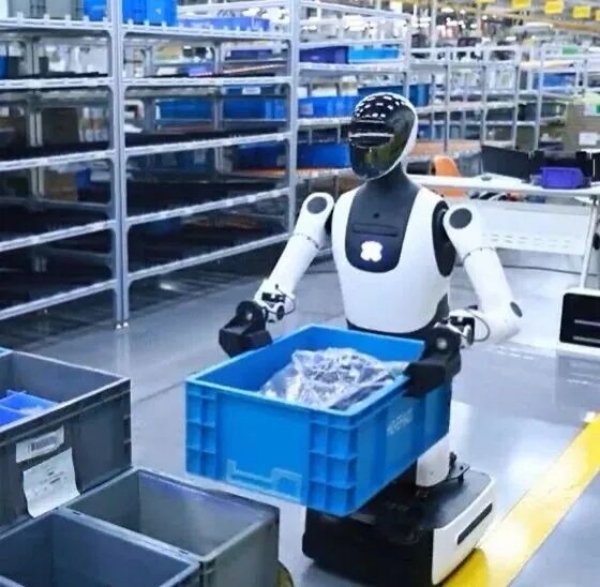
LY iTech's Beijing Embodied Intelligence Super Factory in Beijing E-Town has a planned production capacity of 10,000 units/sets in 2026 and 500,000 units/sets in 2030. It takes only about 15 minutes to complete a full production line changeover, and just 15 minutes to complete final assembly and roll out a unit, with energy consumption 25 percent lower than that of traditional production lines. As of May 2026, the factory had established partnerships with more than 20 leading humanoid robot companies in China.
Galbot's robots now work at convenience stores and are officially incorporated into store staffing schedules. They can autonomously retrieve goods and brew coffee. The company's tennis-playing robots use an in-house large AI model to make decisions and act with 100 percent autonomy.
Approaching.AI is targeting the AI token generation market. Through core technologies such as "heterogeneous inference" and "storage-for-computation" (using storage to cut computing requirements), it has significantly lowered the barriers to deploying large AI models. These solutions are already used in large-scale AI computing clusters at leading enterprises.
From the training data facility to CDMO platforms and from superfactories to real-world applications, Beijing is moving faster to bring sci-tech advances into industrial use, turning progress in AI into a tangible source of economic growth.
(Source: China High-Tech Industry Herald)