

By 2028, Beijing aims to establish itself as a world-class contributor of technological innovation in embodied AI robotics and a leading hub for industrial innovation. The city will nurture no fewer than five world-class and at least 10 domestically leading humanoid robot manufacturers. The Beijing-Tianjin-Hebei region is projected to contribute a quarter of China's total production capacity for complete robots, with the local supply rate of key components exceeding 60 percent. On November 11, the Action Plan for High-Quality Development of Embodied AI Robotics Industry in Beijing (2026–2028) was released, outlining a roadmap for the industry's development over three years.
Beijing will launch six major projects for, respectively, the leapfrog development of embodied AI, the Beijing-Tianjin-Hebei industry chain coordination, the enhancement of the city's role in technological innovation, large-scale application promotion, industrial ecosystem leadership, and prioritized safety governance.
Enhancing the capabilities of embodied AI foundation models is the top priority. The action plan supports breakthroughs via the parallel progress of multiple technological approaches, including vision-language-action (VLA) models, world models (WMs) and reinforcement learning. In terms of the cognitive capacity of robotic "brains", efforts will focus on technologies such as multi-source information fusion, physical environment understanding and human emotion recognition, enabling a leap from "perception" to "cognition". In terms of the "cerebella", priorities will be given to technologies including real-time inference, cross-embodiment transfer and self-learning evolution, to improve multi-task generalization, highly reliable execution, high-speed operation and ultra-precision manipulation. Further efforts will target technologies such as multi-robot collaboration, long-term memory, localized lightweight deployment and model interpretability, to strengthen deployment in real-world applications. These actions are expected to bring Beijing's foundational embodied AI models to a world-class level as a whole.
Regarding the supply of high-quality embodied AI data, Beijing will take the lead in building national-level data infrastructure for embodied AI robots used in a diverse range of real-world scenarios, and collect more than 1 million hours of high-quality data across no fewer than 100 real-world scenarios. In terms of computing support, additional dedicated computing clusters for embodied AI will be built in the city, with a total capacity exceeding 50,000 petaflops. The city will also foster pairing between key enterprises and computing nodes, and carry out collaboration with computing-rich cities outside Beijing through the "Galaxy Computing Corridor" (银河算廊) initiative.
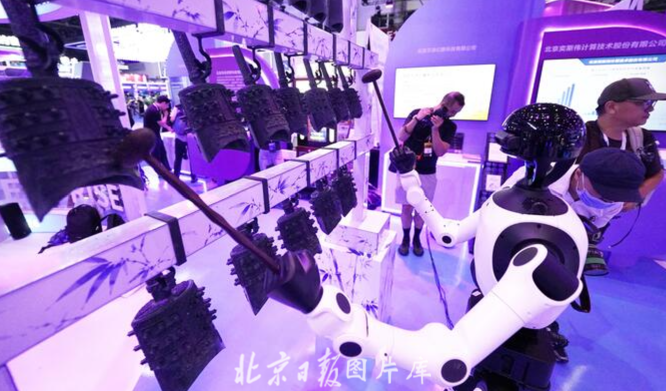
According to the action plan, Beijing will encourage complete-robot and component manufacturers to pursue innovation through collaboration, continuously refine hardware architecture and systematically enhance overall performance, to build a world-class base platform. At the same time, the city will accelerate the building of competitive advantages in key components, including high-efficiency motors, high-precision reducers, integrated joint modules, 6-axis force sensors, dexterous hands, and highly anthropomorphic bionic faces.
Coordinated advancement of industry chains across the Beijing-Tianjin-Hebei region will be a key driver for translating innovation into practical applications. Combining contract manufacturing with self-built production lines, Beijing aims to have an annual production capacity of 200,000 complete robots and establish at least five manufacturing service platforms for embodied AI robots. The local supply rate across the three administrative divisions is expected to exceed 60 percent, with at least 10 shared machining platforms to be built, aimed at shortening the time required for sample delivery after component design revisions from at least one week to one or two days.

In terms of large-scale application and promotion, Beijing will pioneer the development of application innovation platforms for specific vertical segments. In the industrial sector, it will focus on advanced manufacturing and logistics warehousing to form at least 20 benchmark application scenarios. In the service sector, it will focus on elderly care, healthcare, public services, culture, tourism, science education, and supermarket retail to form at least 20 benchmark scenarios. In the special-purpose sector, it will focus on workplace safety, emergency rescue and urban security to form at least 10 benchmark scenarios. Over the next three years, the city will cultivate solution providers and application innovation platforms and develop at least 15 replicable solutions.
Beijing will also explore integrated regional application scenarios in its northern and southern parts. In the north, a robot innovation park will be built in the Olympic Central Area, featuring robot-themed restaurants, hotels and tourism attractions. In the south, support will be given for the iterative upgrading and functional expansion of the Robot World, to turn the Beijing Economic-Technological Development Area into a comprehensive demonstration zone where embodied AI robots are deployed across the full range of real-world scenarios.
(Source: Beijing Daily)

