From pest-monitoring devices connected to the Internet to aquatic weed-removing robots, Beijing's municipal parks are welcoming a group of special "new colleagues". By the end of this month (July), 72 robots and smart devices will be gradually deployed across 14 municipal parks.
At the square east of the Long Corridor inside the Temple of Heaven Park, autonomous cleaning robots have become celebrities for many visitors. Capable of autonomous navigation, obstacle avoidance, self-charging, and round-the-clock operation, these robots can carry out routine environmental cleaning across the park's grounds with minimal human intervention required.
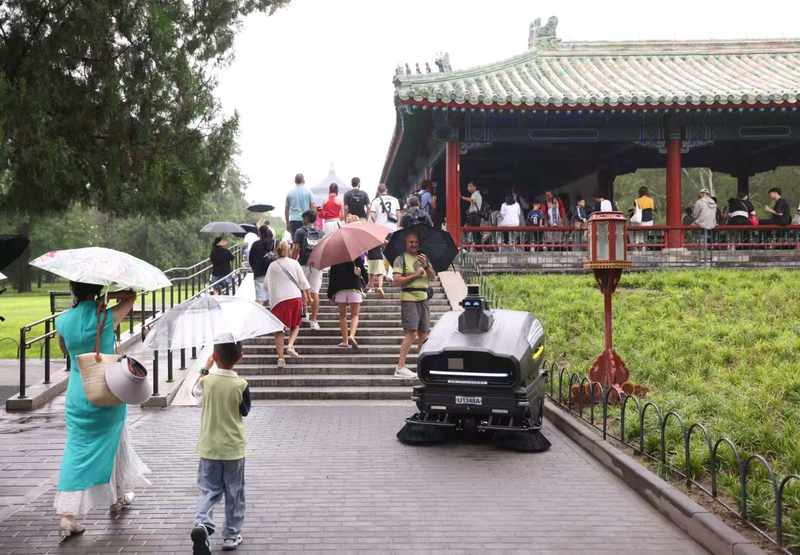
At the Temple of Heaven Park, an autonomous cleaning robot on duty draws attention from visitors.
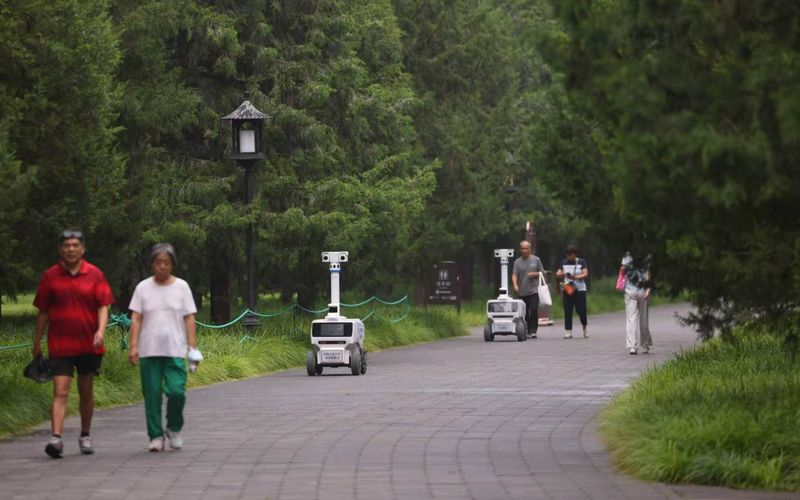
A robot during a smart patrol at the Temple of Heaven Park
In 2025, Yuyuantan Park officially established its Landscape Robot Workstation (园林机器人工作站) to provide a real-world testing environment for innovative robotic technologies and explore how new technologies can empower the development of the landscaping industry. To date, 23 robots from 18 companies have completed their pilot trials at the park.
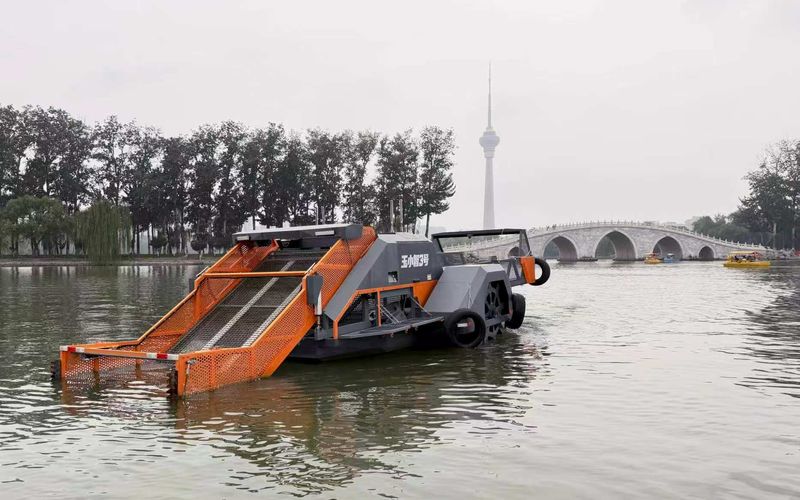
At Yuyuantan Park, an aquatic weed-removing robot is on duty.
The Beijing Municipal Administration Center of Parks is deploying 72 robots across 14 municipal parks, including the Summer Palace, the Temple of Heaven Park, Beihai Park, Taoranting Park, Yuyuantan Park, and Lu County Ancient City Ruins Park. These robots are expected to offer services in six major areas: cleaning and sweeping, intelligent patrol, visitor information services and guided tours, water surface rescue, landscape maintenance, and ecological monitoring.
For cleaning and sweeping, robots powered by large AI models can independently adjust their working strategies based on waste distribution, capable of edge cleaning with precision, automatic obstacle avoidance, and autonomous navigation. Water-surface cleaning robots can automatically identify and collect floating debris such as fallen leaves and plastic bottles, achieving continuous, autonomous water-surface cleaning. Aquatic weed-removing robots meanwhile can harvest, collect, and convey, aimed at efficiently removing submerged plants.
Robots for intelligent patrols are equipped with an AI-powered identification technology and a "device-edge-cloud" computing architecture to identify unsafe and inappropriate behaviors, monitor plant diseases, pests and biodiversity, and detect equipment faults. Autonomous patrol vehicles equipped with a Level-4 autonomous driving technology can also automatically identify sanitation issues, equipment-related safety hazards, and unauthorized commercial activities.
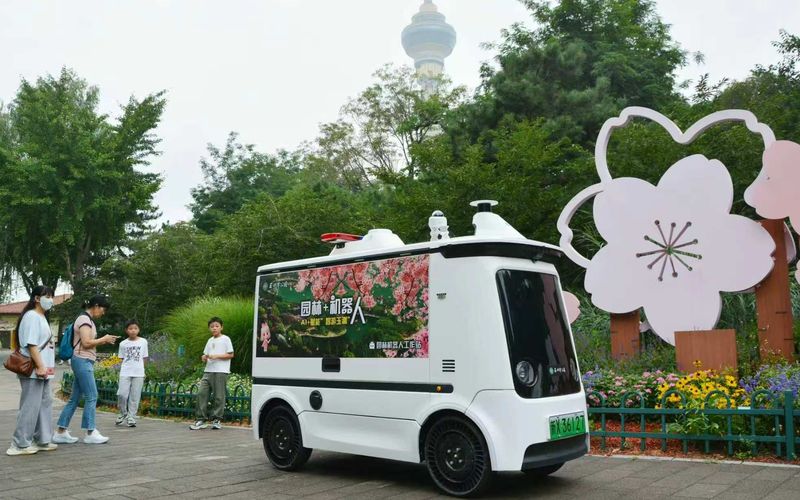
At the square close to the west gate of Yuyuantan Park, an AI-powered patrol vehicle is in operation.
For visitor information services and guided tours, robots powered by technologies, such as those of speech recognition, semantic understanding, and big data knowledge bases, can greet visitors, answer questions, provide directions, offer educational explanations and present promotional information. And there's much more they can do.
In water rescue operations, unmanned rescue boats can be rapidly dispatched and controlled remotely, with AI-powered rescue capabilities. Every boat can be quickly launched from a shore, bridge deck, or vessel to reach the location where a person is in need of help, and carry out rescue operations.
For landscape maintenance, Internet-connected pest-monitoring lamps combine the IoT (Internet of Things) technologies, insect-attracting light sources, intelligent identification systems and more. They can automatically attract and photograph pests, upload data and analyze pest activity, thereby enabling real-time monitoring and dynamic early warnings for pest and disease outbreaks.
In the field of ecological monitoring, AI-powered bird identification devices use audiovisual data to monitor for biodiversity conservation. They help shift the mode of ecological monitoring from manual surveys to 24/7 intelligent monitoring, providing valuable data for biodiversity surveys, scientific research, and ecological protection.
(Source: The Beijing News)