
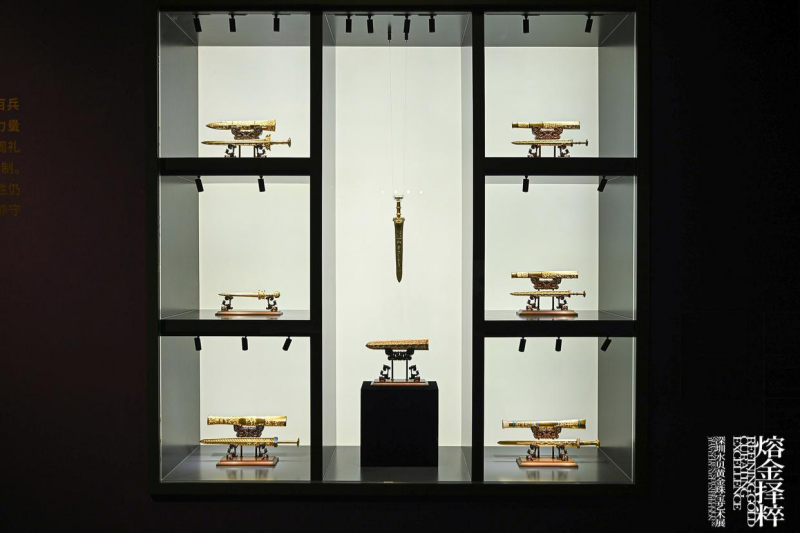
A photo taken at the exhibition
[Photo via The Beijing News]
The exhibition titled "Refining Gold, Curating Excellence: Shenzhen Shuibei Gold and Jewelry Art Exhibition" has recently opened at the Chinese Traditional Culture Museum (CTCM; also known as the "China National Arts and Crafts Museum"). It is the museum's first large-scale special exhibition centered on the gold and jewelry industry in a city of China. Following the core narrative of "National Jewelry", the exhibition gathers works from 77 leading enterprises and independent designer brands, presenting nearly 500 gold and jewelry artworks.
The exhibition will run until August 30, with free admission for the public.
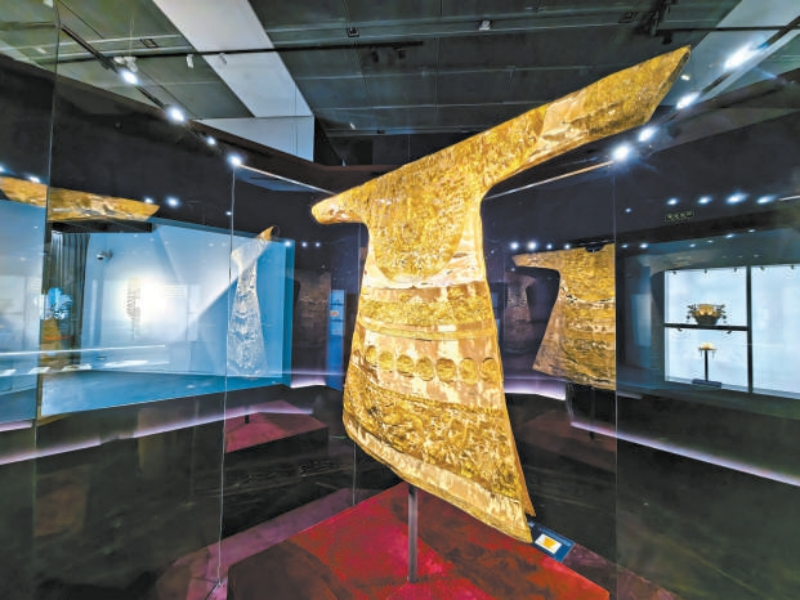
A dragon robe made with gold threads through the techniques of Beijing embroidery
[Photo by An Xudong]
The greatest highlight is a dragon robe made with gold threads through the techniques of Beijing embroidery. It has been certified by Guinness World Records as the "Finest Golden Garment". It took two years to complete this elegant robe of elaborate craftsmanship. Specifically, 43 golden patterns of dragons were embroidered all over the robe together with multiple royal patterns made via traditional stitching techniques, creating vivid three-dimensional effects. The whole garment features 5.1 million stitches, with the total length of gold threads reaching nearly 160 kilometers.
Other exhibits include a phoenix coronet modeled after the coronet (Liulong Sanfeng Guan/六龙三凤冠, which literally means "coronet with six dragons and three phoenixes") of Empress Xiaoduan of the Ming Dynasty, which recreates the exquisite craftsmanship of inlaid silk flowers from the imperial palace. The brooch "Rhythm of Spring" (春之律动) is also ingeniously structured with movable butterfly wings. Hipine's "Twelve Shichens in Intangible Cultural Heritage" (非遗十二时辰; the term "shichen" is a traditional Chinese unit of time, with each corresponding to 2 hours) wristwatch integrates eight crafts listed as intangible cultural heritage items, including chasing (a decoration method), lacquer painting, and kesi (a method for making silk tapestries), fully demonstrating exquisite ingenuity of the designer.
(Sources: Beijing Daily, The Beijing News)