

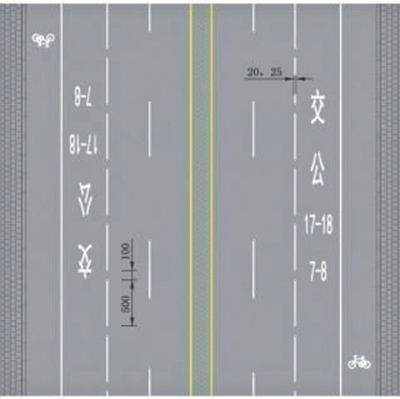
An example of bus lane markings
Drivers on several newly resurfaced roads in Beijing may have noticed a subtle change: the familiar yellow markings for bus lanes have been replaced with white ones. Of course, this doesn't mean that bus lanes have become history. The change was made in accordance with the new edition of China's national standard for road traffic markings.
On May 1, 2026, the updated mandatory national standard Traffic Signs and Markings—Part 3: Traffic Markings came into effect. Under the new standard, the color of bus lane markings is mandated to be changed from yellow to white.
The revised standard also redefines the usage of white and yellow longitudinal road lines. White longitudinal lines are used to separate traffic flowing in the same direction and mark the right edge of every traffic lane. Yellow lines are used to separate opposing traffic flows and indicate the left edge of every roadway, while separating reversible lanes. Besides bus lanes, the color of the markings for bus bays and box junctions has also been changed from yellow to white.
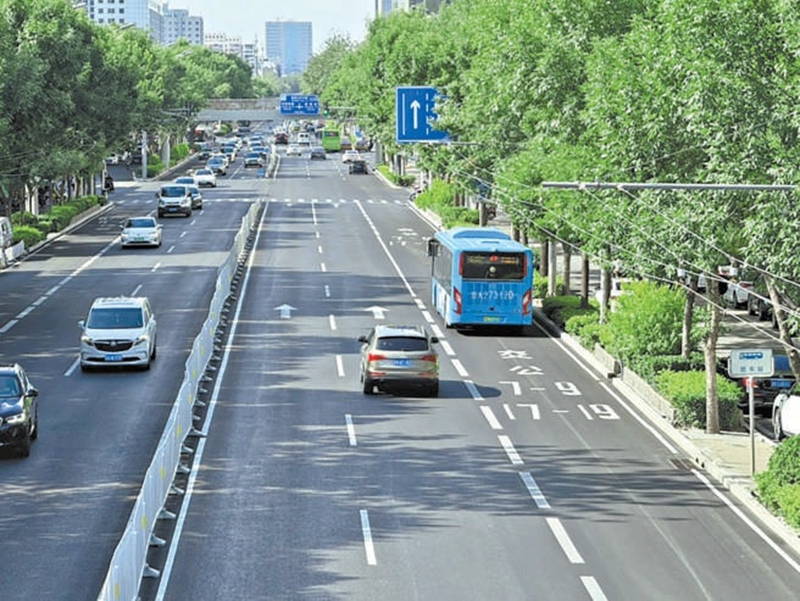
Under the new standard, bus lanes are required to be marked with white dashed lines and white text. Each dashed line segment is 5 meters long, with a 1-meter gap between segments — a pattern also known as the "5-1 line". The line width is set at either 20 centimeters or 25 centimeters. The white text on the lanes reads either "Bus" (公交) or "Bus Rapid Transit" (快速公交).
Beijing will not conduct any targeted adjustment to the existing markings. Instead, the old, yellow markings will be gradually phased out and replaced with the new, white ones through regular road renovation projects.
Beyond the color change for bus lane markings, the latest revision—the most comprehensive one of its kind in nearly 17 years—has also optimized a wide range of traffic symbols. The new national standard unifies graphic symbols for intelligent connected vehicles, cars of ride-hailing services, charging stations, and more. It also introduces a new lane change marking, which shall be at dedicated left/right-turn lanes at intersections and narrowing sections, clearly alerting drivers to potential lane changes and delivering more explicit guidance for all drivers.
(Source: Beijing Daily)