From November 4 to 5, 2026 (UTC+0), several events of the "Charming Beijing" series were held in Rabat, the capital of Morocco. Focusing on the ancient Silk Road civilizations and the contemporary China-Morocco exchanges, the events included the final round and awards ceremony of a speech contest themed "Youth in Dialogue on Chinese and Egyptian Civilizations", and the "Twin Stars on Silk Road: Messengers of Civilizations" cross-cultural dialogue. These were complemented by screenings of the "Charming Beijing" sci-tech documentaries, a cultural gathering, and an automobile exhibition by BAIC Group.
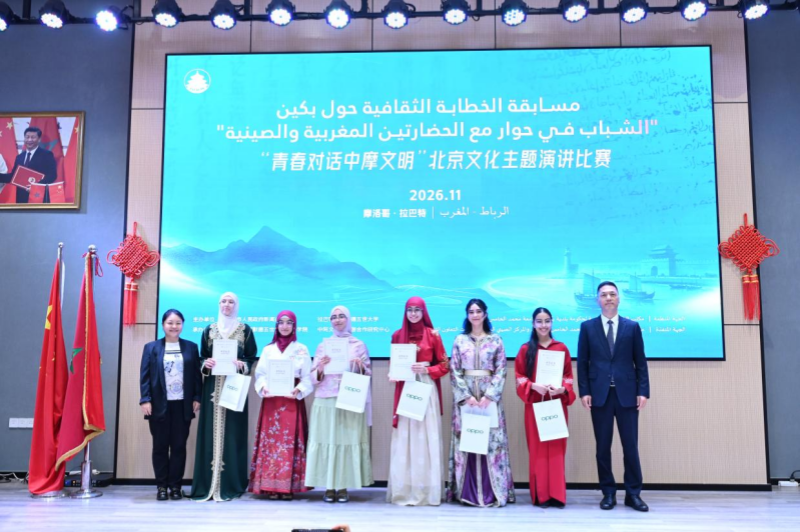
On November 4, the final round and awards ceremony of a speech contest themed "Youth in Dialogue on Chinese and Egyptian Civilizations" and centered on Beijing's culture were held at the Confucius Institute at Mohammed V University in Rabat. The contest was open to Chinese-language learners and enthusiasts at Moroccan universities. Following preliminary rounds, nine contestants advanced to the final round, where they delivered speeches in Chinese on topics such as Beijing's history and culture, urban development, and friendly exchanges between China and Morocco. After the competition, the three first-prize winners expressed their gratitude to the organizers for hosting the event, noting that it provided them with an opportunity to showcase their proficiency in Chinese and to inspire more young Moroccans to learn the language and understand Chinese culture. They described Beijing as a city that is both ancient and modern and is marked by rapid technological development, and expressed their hope to facilitate cultural exchanges between China and Morocco and contribute to greater ties among young people in both countries.
Alongside the speech contest, the Confucius Institute at Mohammed V University organized the screenings of the "Charming Beijing" sci-tech documentaries, a cultural gathering, and an exhibition of vehicles from BAIC Group. Viewers remarked that the footage of agile robots competing gave them a vivid sense of the dynamism of China's cutting-edge technology. Young people from Moroccan universities expressed an even stronger interest in drawing on China's experience in sci-tech innovation, deepening youth exchanges in this field, and working together to explore the future of artificial intelligence and humanoid robots.

The interactive cultural gathering featured activities involving traditional handicrafts, such as lacquer fan-making and "fanlihua" (翻里花, literally "flipped paper flower"), and showcased Beijing's unique cultural souvenirs, including postcards depicting the Central Axis and refrigerator magnets featuring architectural patterns. Visitors also had the chance to try on hanfu (traditional clothes of the Han ethnic group), and take part in a stamp-collecting challenge and a quiz about Beijing's cultural trivia. Themed photo zones were also available. This immersive cultural event attracted many young Moroccans to take part, presenting to them the different cultural aspects of Beijing, such as architecture, folk customs and cuisine, as well as the city's progress in sci-tech innovation.
On November 4, the signing and unveiling ceremony for the China-Morocco Center for Studies of Cultural and Tourism Cooperation was held at the Confucius Institute at Mohammed V University. The institution was jointly launched by Beijing International Studies University and Mohammed V University. On November 5, the "Twin Stars on Silk Road: Messengers of Civilizations" cross-cultural dialogue featuring Ibn Battuta and Wang Dayuan (two famous travelers) took place at the Confucius Institute at Mohammed V University.