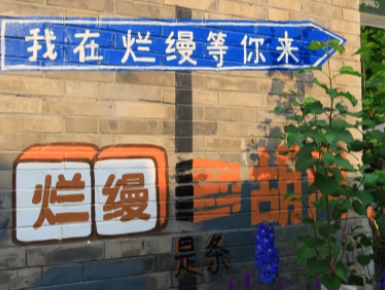
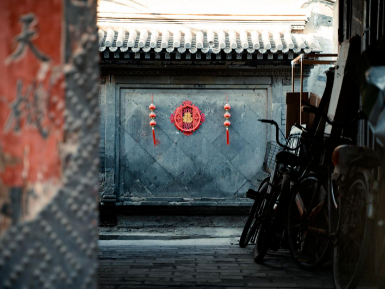
Beijing 'Root of Hutong' Cultural Experience Center Opens in Zhuanta Hutong

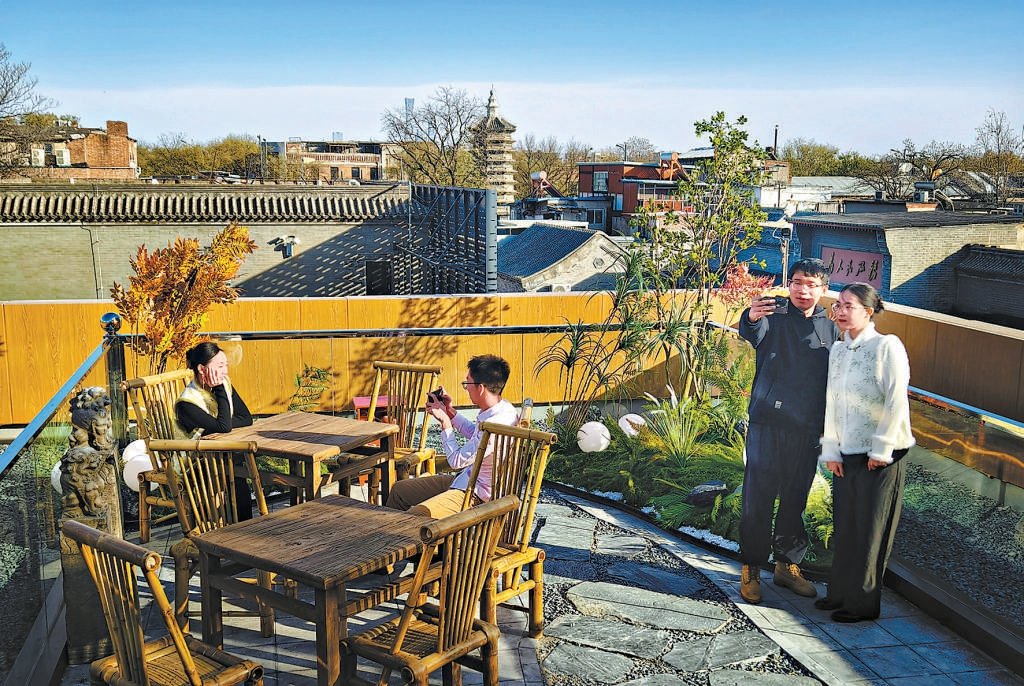
The rooftop terrace has become a new tourist hotspot overlooking the blend of gray-brick hutong roofs and the modern cityscape.
On November 24, the establishment located at No. 33 Zhuanta Hutong (砖塔胡同) in Xicheng District became the Beijing "Root of Hutong" Cultural Experience Center. This venue represents one of the cases of urban renewal following an application-based voluntary lease termination and serves as a new cultural tourism attraction to one of Beijing's oldest hutongs.
Zhuanta Hutong was built during the Yuan Dynasty and is one of the oldest hutongs in Beijing. It is also the only hutong with historical records of the Yuan (1271–1368), Ming (1368–1644), and Qing (1644–1911) dynasties, and the Republic of China era (1911–1949), earning it the name "the root of all hutongs".
Stepping into the experience center, visitors can enjoy specialty drinks in the "Root of Hutong" tea space or choose from a variety of creative souvenirs at the themed postal shop. The souvenirs displayed here are inspired by classic architectural symbols such as siheyuans (quadrangles) in hutongs, gate towers, brick carvings, and lattice windows. Some items include the "Root of Hutong" 3D paper sculpture books, the 3D pop-up sticky notes inspired by Beijing's siheyuan, and fridge magnets carrying auspicious elements including the phrase "Fu-Lu-Shou-Xi-Cai" (福禄寿喜财, which are five Chinese characters symbolizing blessing, prosperity, longevity, happiness, and wealth, respectively) and lotus patterns. There is also "Zhuan Bao'er" (砖宝儿), which is a mascot named after Zhuanta Hutong, along with various plush animal toys, many of which incorporate the design elements of hutongs.
On the second floor, a special mural art exhibition titled "Heavy Colors and Golden Threads — Echoes in Hutong: A Millennium of Wall Traces from Dunhuang to Fahai Temple" is currently underway. Through murals, the exhibition brings the vastness of Dunhuang and the refined solemnity of Fahai Temple together within one hutong.
It is not alone. Together with Zhengyang Bookstore (正阳书局) in Wansong Laoren Pagoda Courtyard at the east entrance of the hutong, Jingpin Shangyin Café (京品尚饮咖啡馆) at No. 8 of the hutong, Shangjia Jingpin Wellness Hall (尚嘉京品养生堂) at No. 15, and Shangjia Huafu Restaurant (尚家化府餐厅) at No. 36, it injects new vitality into this ancient alley.
(Source: Beijing Daily)