

According to the Beijing Municipal Commission of Transport, the commute time from Beijing to the Tianjin-Hebei region will be further shortened. Additionally, the suburban railway will "diversify" in seven major directions, providing rapid commuting services for residents in Beijing's remote suburban counties and surrounding areas.
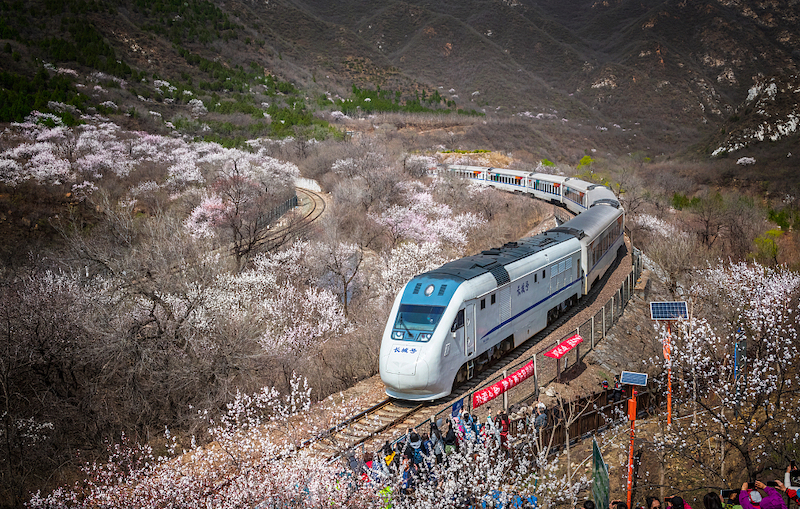
[Photo via VCG]
Zhao Yang, Director of the Coordinated Development Division of the Beijing Municipal Commission of Transport, introduced that the Beijing-Zhangjiakou high-speed railway, Beijing-Harbin high-speed railway, Beijing-Tangshan intercity railway and other infrastructural lines of transport have not only been completed, but put into operation. The Xiong'an-Shangqiu, Xiong'an-Xinzhou, and Tianjin-Weifang high-speed railways have been under accelerated construction. These efforts will provide all the cities above the prefecture level in the areas with access to high-speed railways. It will take only one hour for travelers commuting from Beijing to reach the six adjacent areas, with greatly reduced time for transport between the Beijing-Tianjin-Hebei region and surrounding areas such as the Northeast, the Central Plains, and the Shandong Peninsula. Concurrently, the construction of the first cross-city rail transit Pinggu Line in the Beijing-Tianjin-Hebei region has been accelerated, and the section in Sanhe City has a total length of about 30 kilometers and five stations. This project is expected to be completed by the end of 2025, and the shortest commuting time from Yanjiao to central Beijing will be approximately 32 minutes after its completion.
A number of railway stations in Beijing and Tianjin have implemented information-sharing and mutual recognition of security inspections between railway and urban rail transit, providing seamless transfer between high-speed, suburban and urban rails.
After the completion of the Fengtai-Xiong'an-Shangqiu high-speed railway, which is currently underway, the time for commuting from Beijing to Hengshui will be shortened to one hour. The suburban railway will "diversify" in seven main directions, namely east, southeast, south, southwest, west, northwest and northeast. The east and west lines will connect the central urban area with the sub-center of the city to facilitate the reduction of the central urban area's functions which are not in line with the positioning of the city as the national capital, and provide rapid commuting services for residents of Beijing's remote suburban counties and surrounding areas.
(Source: Beijing Evening News)