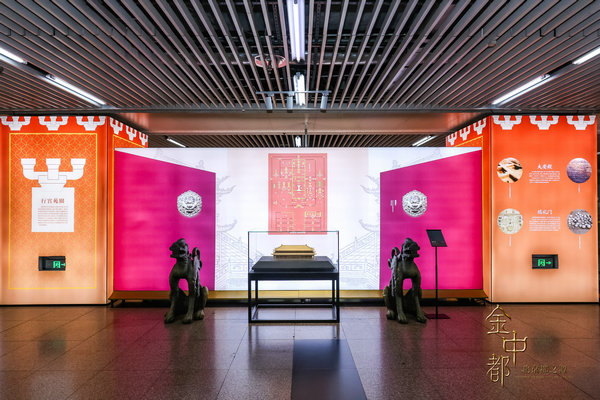
The Jinzhongdu — Origin of Beijing as Capital exhibition transforms a passageway of the Beijing West Railway Station into a time tunnel, transporting visitors back 873 years to the birth of Beijing as a national capital, with a display of archaeological findings from the Jinzhongdu site.
[Photo provided to chinadaily.com.cn]
On the underground second floor of Beijing West Railway Station, amid the summer rush of travelers dragging suitcases toward their trains, a different kind of journey is unfolding.
The Jinzhongdu — Origin of Beijing as Capital exhibition opened to the public on July 30, bringing together years of archaeological findings from the Jinzhongdu site. Co-hosted by the Beijing Archaeological Site Museum and the Beijing West Railway Station Area Management Office, the exhibition transforms the subway's east passageway into a time tunnel, transporting visitors back 873 years to the birth of Beijing as a national capital.
In 1153, Emperor Wanyan Liang of the Jin Dynasty (1115-1234) moved the capital from Shangjing (in present-day Heilongjiang province) to Yanjing — present-day Beijing — and renamed it Zhongdu, meaning "central capital". Among the dynasty's five capitals, it occupied the central position.
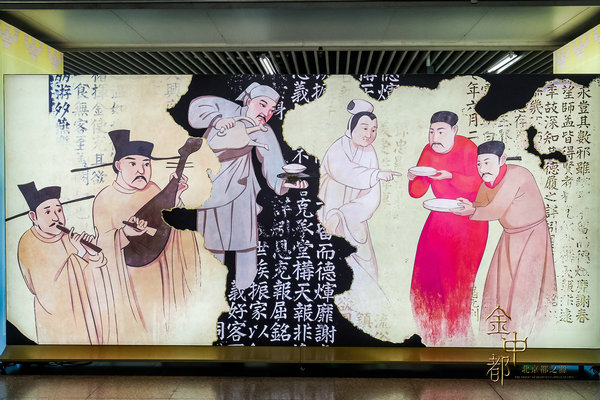
The Jinzhongdu — Origin of Beijing as Capital exhibition transforms a passageway of the Beijing West Railway Station into a time tunnel, transporting visitors back 873 years to the birth of Beijing as a national capital, with a display of archaeological findings from the Jinzhongdu site.
[Photo provided to chinadaily.com.cn]
Jinzhongdu was built around a prominent central axis with a symmetrical layout. It featured outer, imperial and palace city walls, 13 gates in the outer city, and an orderly grid of streets and alleys, making it the most prosperous city in northern China at the time.
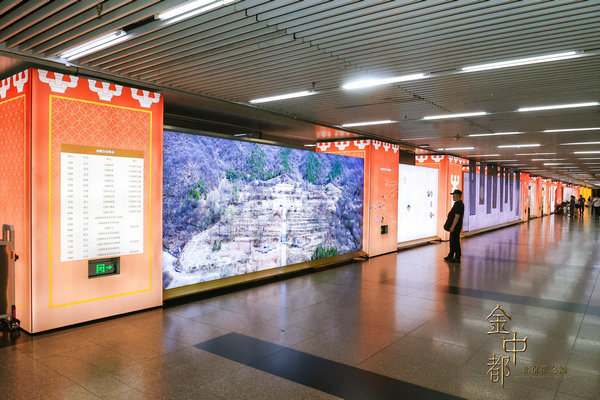
The Jinzhongdu — Origin of Beijing as Capital exhibition transforms a passageway of the Beijing West Railway Station into a time tunnel, transporting visitors back 873 years to the birth of Beijing as a national capital, with a display of archaeological findings from the Jinzhongdu site.
[Photo provided to chinadaily.com.cn]
Jinzhongdu was a thriving commercial hub where nomadic and Han Chinese cultures intertwined. Tea drinking was popular across all social classes, with teahouses and taverns lining the city streets. The Jin emperors were patrons of literature and the arts. Wanyan Liang wrote poetry in a bold style, while Emperor Zhangzong's verses were more refined.
Although most of Jinzhongdu's buildings have long disappeared, decades of archaeological work have gradually brought the ancient capital back into public view. One striking example lies just outside the station: during the planning of Beijing West Railway Station in the early 1990s, the site was moved 100 meters eastward to preserve the Lotus Pond. Today, the pond and the modern station stand facing each other across time. The place becomes a unique urban landscape where ancient and contemporary Beijing meet.
The exhibition is part of a broader initiative to integrate public culture into Beijing's major transportation hubs. This is the third such exhibition the museum has staged at a railway station, following displays at Tongzhou and Beijing North stations. But the West Station exhibition is the largest and most comprehensive so far.
The exhibition is free and open to the public.