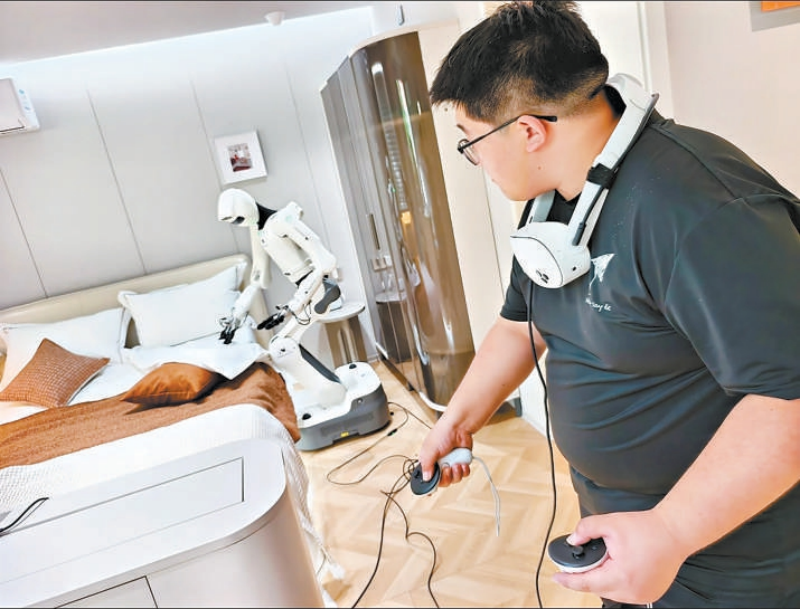
A trainer is training a robot to make a bed.
[Photo by Sun Ying]
Two of the talent apartments of the AI Genesis Community in Haidian District of Beijing, originally designed for human residents, have been transformed into real-world testing grounds for AI data for robots. Under the guidance of trainers, robots are learning to perform a range of household tasks, including washing cups, preparing meals, making beds and cleaning rooms.
For robots to operate effectively in the real world, they need vast amounts of data collected from real-life environments. Previously, data training relied primarily on simulation tests and laboratory data collection. While simulations can generate large volumes of data, they often lack sufficient diversity. Laboratories, meanwhile, are constrained by space and cannot fully replicate the variety and complexity of real-world environments.
By converting everyday-life scenarios into testing grounds for innovation, the AI Genesis Community helps companies reduce trial-and-error costs for data collection. It is also exploring a new way for collective assets to serve new quality productive forces, aiming to unlock huge industrial potential within a compact space.
Located in Wudaokou of Haidian District, the AI Genesis Community was named one of the world's top 10 innovation zones in 2025. It is now home to more than 30 universities and research institutions as well as over 400 AI enterprises, with a large number of AI research talents. Cutting-edge technology is already becoming part of everyday community life, as robots can serve as shop assistants, make ice cream, prepare milk tea and brew coffee. Going forward, the community will gradually open more spaces such as office buildings, stores and supermarkets for robot training.
(Source: Beijing Daily)