Beijing-Developed Motion Framework Enables Humanoid Robots to Perform Dozens of Demanding Movements Including Thomas Flair


[Photo via VCG]
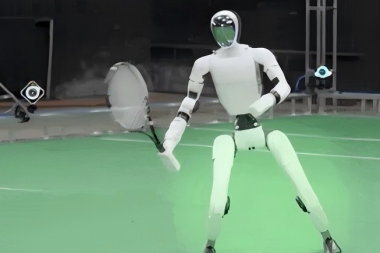
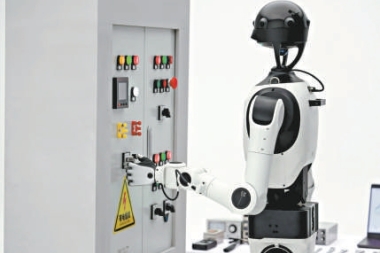
On March 6, the Beijing Institute for General Artificial Intelligence (BIGAI) unveiled OmniXtreme, a next-generation general motion control framework for humanoid robots. The framework allows robots to perform dozens of highly dynamic and extreme movements—such as backflips, Thomas flair, and martial arts kicks—with a single unified algorithm, achieving high success rates in real-world deployment.
Unlike traditional reinforcement learning approaches that train a single unified policy from scratch, OmniXtreme requires robots to go through a two-stage learning process. The research team first develops, through training, specialized "expert policies" for different movements, then incorporates reinforcement learning that takes into account the physical characteristics of real motors. This approach significantly enhances the framework's executability on actual robots. Test results show that the framework achieves a success rate of over 90 percent in a variety of highly dynamic motion tasks, providing a strong foundation for more complex robot skill learning in the future.
The birth of OmniXtreme resulted directly from the nurturing environment of Beijing's sci-tech innovation. In April 2025, BIGAI officially launched the "Tongzhi Brain" (通智大脑) platform, through which it equips robots with a universally applicable and thinking-enabled decision-making core, as well as a motion control system that enhances coordination, based on the core technology of the world's first general AI humanoid robot named "Tong Tong" (通通). OmniXtreme is a key technological component behind this motion control capability. The "Tongzhi Brain" platform is currently moving toward industrialization, and is expected to play a role in a variety of other robotic platforms in the future, enabling robots to demonstrate stronger performance and greater adaptability to complex environments.
(Source: Beijing Daily)