

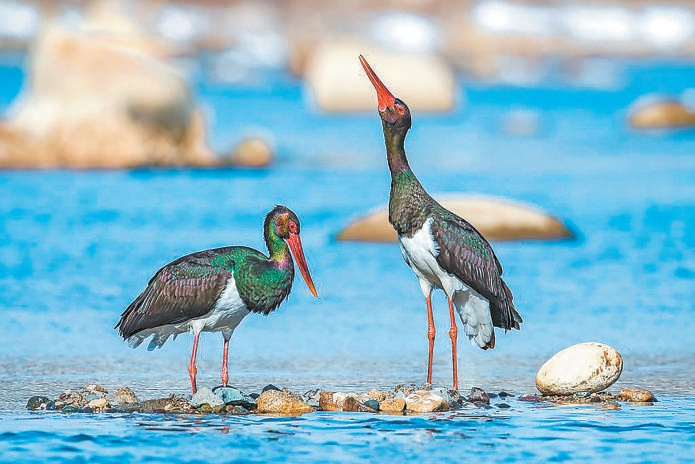
Black stork
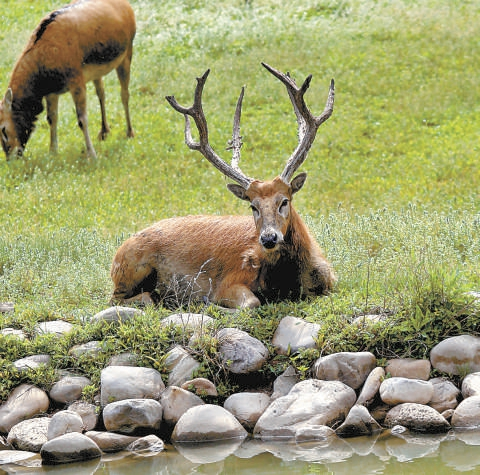
Milu deer

Yellow weasel
Water crowfoot
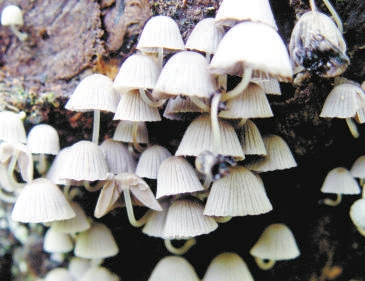
Fairy inkcap mushrooms
The International Day for Biological Diversity is celebrated annually on May 22. Preceding this day, on May 21, a symposium on biodiversity conservation and high-quality urban development took place. As per the symposium, Beijing currently boasts 79 nature reserves, covering an area that accounts for 20 percent of the city's total area. These reserves serve as habitats for 608 species of terrestrial vertebrates and 2,088 species of higher plants.
Sha Haijiang, Deputy Director General of the Beijing Municipal Forestry and Parks Bureau, provided an overview stating that Beijing is currently home to 608 species of wild terrestrial vertebrates, including 128 species that are designated as key protected wild animals in China. Additionally, a diverse range of 2,088 higher plant species has been discovered, of which 15 species hold the status of key protected wild plants in China. In terms of ex-situ conservation efforts, the China National Botanical Garden has amassed a collection of over 10,000 plant species from around the world, with nearly 5,000 species successfully cultivated and nurtured in greenhouses.
Over the past two years, Beijing has witnessed the discovery of 12 new species of wild animals, exclusively birds. Extensive monitoring efforts have revealed a total of 515 bird species that either inhabit or temporarily visit Beijing, securing the city's second position among the capitals of G20 nations in terms of the bird population.
Over the past two years, Beijing has witnessed the discovery of 12 new species of wild animals, exclusively birds. Extensive monitoring efforts have revealed a total of 515 bird species that either inhabit or temporarily visit Beijing, securing the city's second position among the capitals of G20 nations in terms of the bird population.
Zhou Caixian, Division Director of the Nature Reserve Division of the Beijing Municipal Forestry and Parks Bureau, revealed that Beijing has established a comprehensive network of 79 designated nature reserves across five different categories. These reserves collectively cover approximately 20 percent of the city's total area. In addition to these reserves, Beijing has also designated 135 natural zones within urban parks, suburban parks, and ecological forests.
As per a spokesperson from the Beijing Municipal Forestry and Parks Bureau, the forest in Beijing now spans an impressive 44.6 percent of the city's total land area. Furthermore, over 12,000 hectares of wetlands have been successfully restored. Beijing is currently undertaking the planning phase for the Yanshan Mountain-Saihanba National Park, demonstrating its commitment to expanding and preserving natural areas.
Sha Haijiang emphasized Beijing's commitment to exploring the potential of ecological products, fostering a thriving "bird-watching economy", and cultivating diverse ecological tourism offerings. To this end, the Beijing Municipal Forestry and Parks Bureau has unveiled 45 designated bird-watching spots, including renowned locations like Beihai Park, Shidu Scenic Area in Fangshan District, and Yeya Lake. Moreover, Miyun District is actively establishing a natural science education base centered on "bird-watching", while developing new bird-watching tour routes. Fangshan District has made significant strides in enhancing bird-watching facilities, positioning Shidu Scenic Area as Beijing's first "Bird-watching Town".
(Source: Beijing Daily)